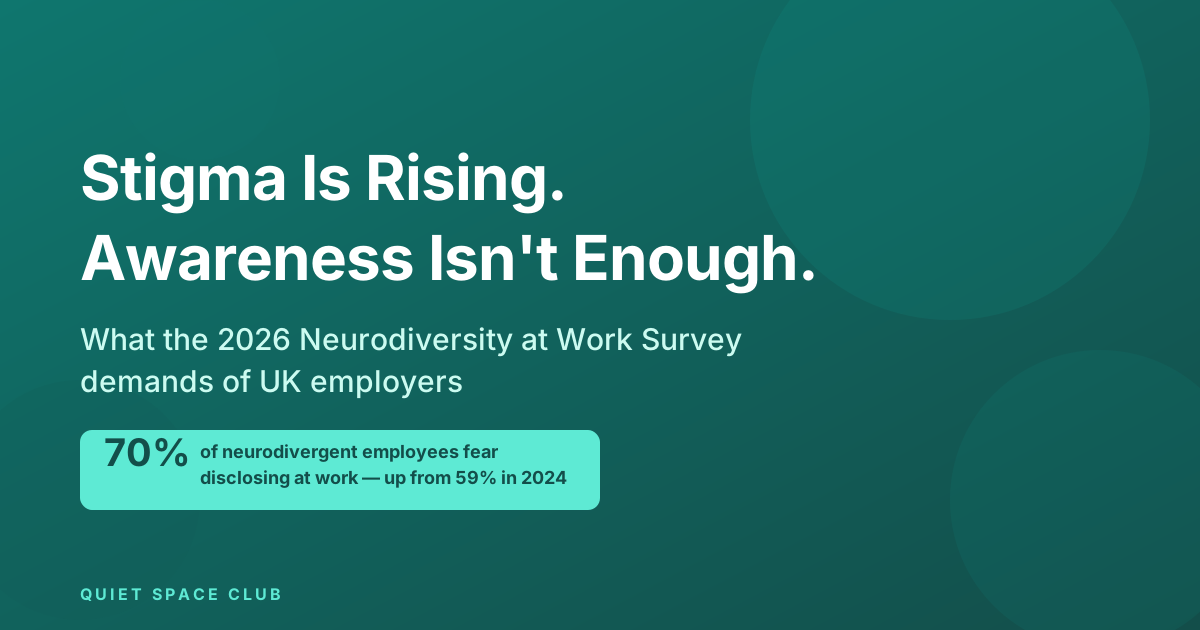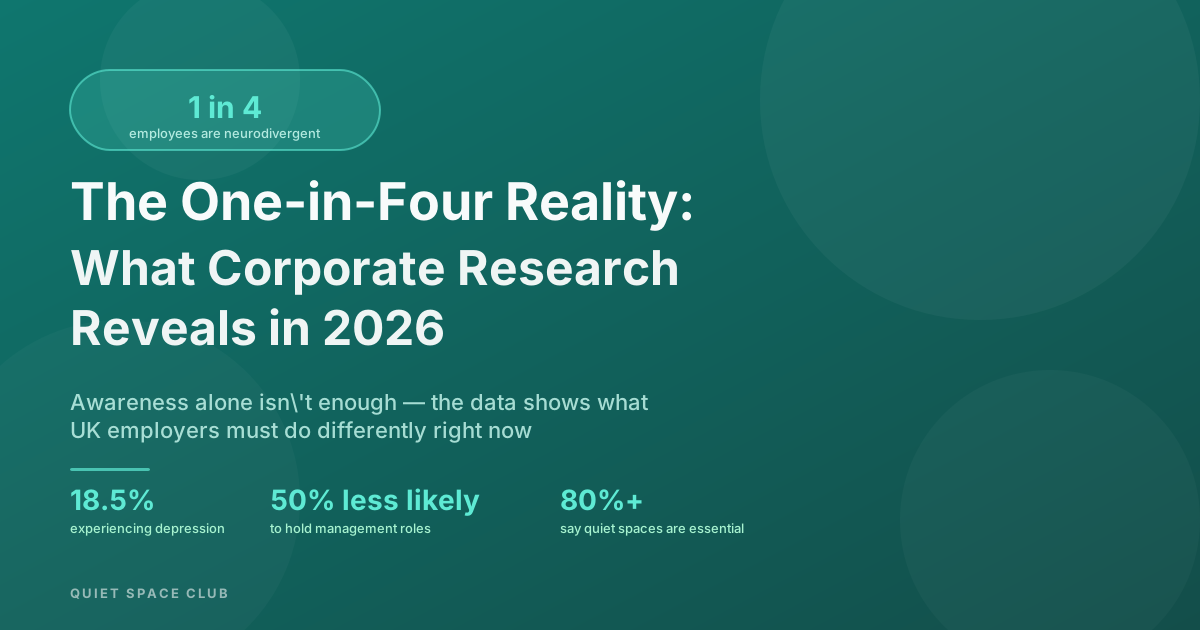
Up to 90% of autistic people report sensory sensitivities that impact daily functioning. Yet most UK offices ignore these needs, creating environments where neurodiverse professionals struggle to focus, manage stress, or maintain productivity. This article explores how to define truly inclusive workspaces that address the unique sensory and cognitive requirements of individuals with ADHD, autism, and related conditions through evidence-based design.
Key takeaways
| Point | Details |
|---|---|
| Sensory overload is common | Neurodiverse professionals often struggle in standard office environments due to excessive noise, harsh lighting, and visual clutter. |
| Adaptable design is essential | Inclusive workspaces use adjustable lighting, acoustic treatments, and flexible layouts to reduce sensory stress. |
| Evaluation frameworks matter | Tools like NeuroIndex provide standardised metrics to assess whether workspaces meet genuine neurodiverse needs. |
| Legal protections exist | The UK Equality Act 2010 requires employers to make reasonable sensory-related workplace adjustments. |
| Community design is critical | Social support structures and balanced interaction spaces enhance workplace satisfaction alongside physical modifications. |
Foundations of inclusive workspaces for neurodiversity
Sensory processing differences are fundamental to understanding autism and ADHD in workplace contexts. Up to 90% of autistic people report sensory sensitivities that directly impact their ability to function effectively in typical office environments. These differences affect how individuals perceive and respond to noise, lighting, spatial organisation, and even tactile sensations from furniture or fabrics.
Most standard UK offices feature open-plan layouts with high ambient noise levels, fluorescent or LED lighting that flickers imperceptibly to neurotypical workers but painfully to others, and visual clutter from densely packed desks and constant movement. These elements create a sensory environment that can quickly overwhelm neurodiverse professionals.
Current workplace design rarely provides the flexibility or environmental controls necessary to mitigate these challenges. Fixed lighting systems, limited access to quiet spaces, and rigid desk arrangements leave neurodiverse workers with few options to regulate their sensory input throughout the workday.
Key sensory challenges in typical workspaces include:
- Unpredictable or constant background noise from conversations, equipment, and foot traffic
- Harsh overhead lighting that cannot be dimmed or adjusted to individual preference
- Visual overstimulation from cluttered environments and high-traffic sightlines
- Lack of dedicated quiet zones or sensory retreat spaces
- Inflexible seating arrangements that prevent personalisation of immediate workspace
Platforms like NeuroIndex have emerged to address these gaps by connecting neurodiverse professionals with certified workspace providers that meet evidence-based standards for sensory accessibility. The NeuroFlow assessment process evaluates spaces against comprehensive criteria informed by research on sensory processing in autism and related conditions.
Key environmental adaptations in neuro-inclusive workspaces
Effective neuro-inclusive design focuses on specific environmental modifications that reduce sensory overload and enhance focus. Acoustic treatments represent one of the most critical interventions. Sound-absorbing materials on walls and ceilings, acoustic panels strategically placed throughout open areas, and dedicated quiet zones help manage noise levels that otherwise trigger stress responses in neurodiverse individuals.
Lighting adaptability is equally essential. Research shows that natural light exposure correlates with 15-20% reduced stress markers in neurodiverse office workers. Workspaces that maximise natural light whilst providing individual control over artificial lighting through dimmable fixtures, task lamps, and adjustable colour temperatures allow workers to tailor their environment to their current sensory needs.

Spatial layout considerations extend beyond simple desk arrangement. Studies demonstrate that workspace modifications decreased sensory discomfort by 40% and improved focus duration by 30% in neurodiverse adults.
Practical environmental features include:
- Acoustic panels and carpeting to absorb sound rather than hard surfaces that amplify it
- Adjustable LED lighting systems with dimming capabilities and warm colour temperature options
- Partition screens or plants to create visual boundaries without full enclosure
- Dedicated quiet rooms separate from general break areas
- Flexible furniture allowing workers to modify desk height, chair support, and workstation layout
Pro Tip
Test different lighting conditions throughout your workday to identify when you need brighter or dimmer environments, then communicate these patterns to workspace providers or employers to secure appropriate accommodations.
Common misconceptions about inclusive workspaces
Many organisations mistakenly believe that simply providing quiet spaces makes a workplace neuro-inclusive. Whilst reduced noise is important, true inclusivity requires addressing multiple sensory dimensions simultaneously. A quiet room with harsh fluorescent lighting and no temperature control may still trigger sensory overload for many neurodiverse individuals.
Another widespread misconception assumes that one-size-fits-all accommodations suit all neurodiverse workers. Sensory profiles vary dramatically even amongst individuals with the same diagnosis. Some people with ADHD thrive with background music or ambient noise, whilst others require near-silence.
Organisations also frequently overlook the importance of community and social design elements, focusing exclusively on physical environment modifications. Yet workplace satisfaction for neurodiverse professionals depends equally on having appropriate social spaces, peer support opportunities, and cultural acceptance of sensory needs.
Common misconceptions include:
- Believing silence alone equals inclusivity without considering lighting, spatial, or temperature factors
- Assuming identical accommodations work for everyone with ADHD or autism
- Thinking physical modifications suffice without cultural or community support changes
- Expecting neurodiverse workers to adapt to standard environments with minor tweaks
- Viewing accessibility as a one-time implementation rather than ongoing refinement
Pro Tip
Ask workspace providers specific questions about adjustability and personalisation options rather than accepting generic accessibility claims. Truly inclusive spaces empower individual control over multiple environmental factors.
Frameworks to evaluate and compare neuro-inclusive workspaces
Systematic evaluation frameworks enable objective assessment of workspace suitability for neurodiverse needs. Comprehensive frameworks examine multiple dimensions: sensory environment controls, spatial flexibility and privacy options, assistive technology availability, community support structures, and proximity to essential services or transport links.
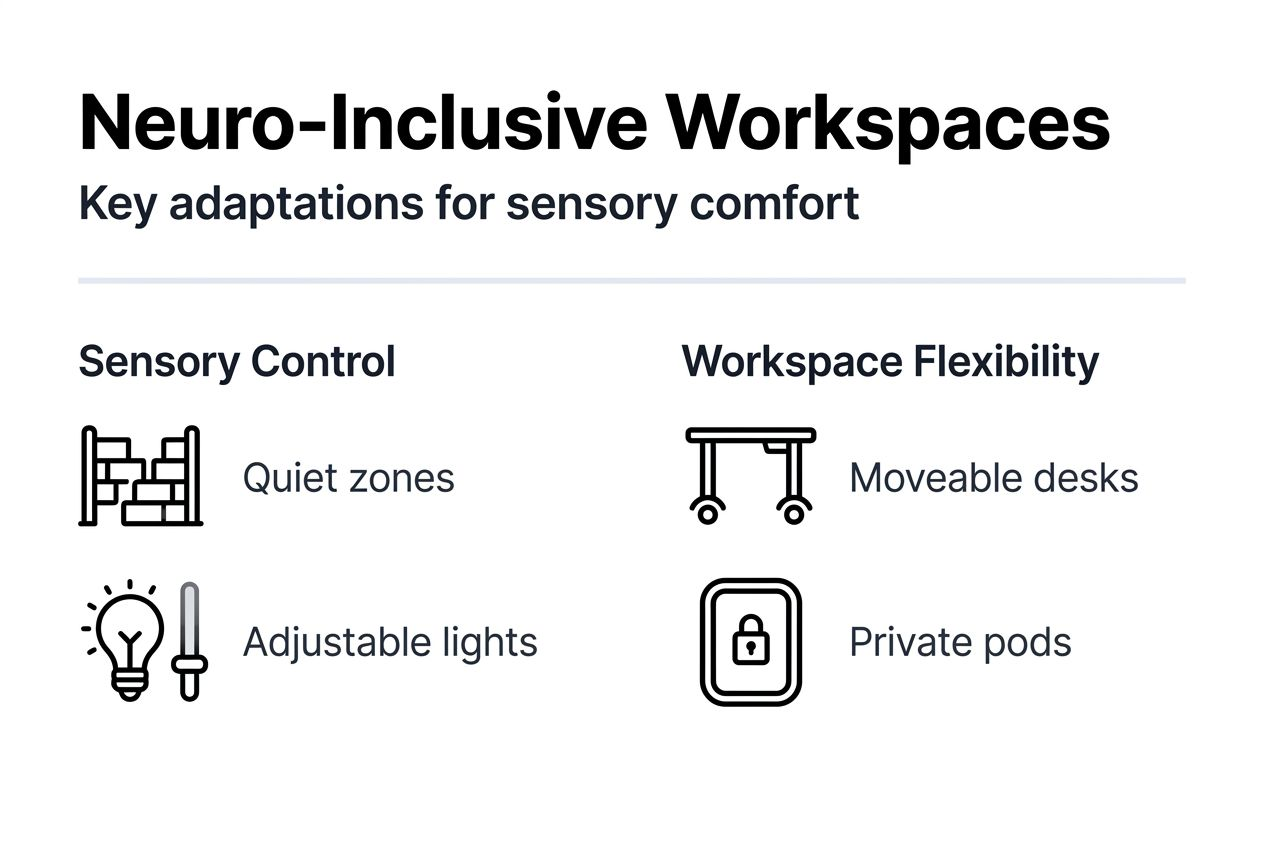
Structured evaluation using these frameworks promotes transparent, evidence-based decisions. Rather than relying on subjective impressions or marketing claims, professionals can systematically compare workspaces against standardised criteria.
Key evaluation criteria:
- Sensory environment: Noise levels, lighting adjustability, visual complexity, air quality, temperature control
- Spatial design: Quiet zones, collaborative areas, privacy options, desk variety, personalisation allowances
- Technology support: Assistive devices, ergonomic equipment, connectivity reliability, software accessibility
- Community resources: Peer networks, staff training, accommodation policies, social space design
- Location factors: Transport accessibility, sensory environment of surrounding area, proximity to quiet outdoor spaces
| Criterion | Standard Workspace | Neuro-Inclusive Workspace |
|---|---|---|
| Noise control | Open plan, constant background noise | Acoustic treatments, quiet zones available |
| Lighting | Fixed fluorescent/LED, no adjustment | Dimmable, natural light maximised, individual lamps |
| Spatial flexibility | Assigned desks, uniform layout | Varied seating options, adjustable configurations |
| Community support | Generic facilities, minimal awareness | Peer networks, trained staff, sensory-aware culture |
| Technology access | Standard equipment only | Assistive devices, ergonomic options provided |
NeuroIndex: a quantitative certification for neuro-inclusive workspaces
NeuroIndex functions as an evidence-based certification system that applies standardised metrics to evaluate workspace sensory comfort and accessibility. Unlike subjective reviews or marketing claims, the system uses on-site assessments conducted by trained specialists who measure environmental factors against neuroscience-informed benchmarks.
The certification process examines acoustic properties through decibel measurements at different times and locations, lighting through lux readings and flicker testing, spatial organisation through layout analysis and privacy assessments, and community support through policy review and staff interviews.
NeuroIndex certification benefits include:
- Standardised evaluation: Objective metrics ensure consistent assessment across different spaces and locations
- Specialist verification: On-site assessments by trained evaluators prevent inaccurate self-reporting
- Transparent scoring: Clear numerical ratings help professionals compare options quickly
- Provider credibility: Certification signals authentic commitment to neurodiverse accessibility
- Improvement guidance: Detailed reports show providers exactly which modifications would enhance inclusivity
Case studies of neurodiverse workspace adaptations
UK coworking spaces reported 18% productivity increases and 50% fewer sensory overload incidents following comprehensive adaptations including acoustic treatments, adjustable lighting systems, and dedicated quiet zones.
One London coworking provider installed sound-absorbing panels throughout open areas, replaced fluorescent fixtures with dimmable LED systems allowing individual control, and converted two unused meeting rooms into sensory retreat spaces. Member surveys conducted three months post-implementation showed dramatic improvements in focus duration, stress levels, and overall satisfaction amongst neurodiverse users.
A Manchester office space focused on spatial reconfiguration, creating varied work zones from enclosed pods to semi-private desk clusters to open collaborative areas. User feedback emphasised the importance of choice and control, with 87% of neurodiverse members reporting they could now work effectively throughout the day.
| Workspace | Location | Primary Adaptations | Measured Outcomes |
|---|---|---|---|
| Urban Cowork Hub | London | Acoustic panels, dimmable LED lighting, quiet zones | 18% productivity increase, 50% fewer overload incidents |
| Flex Office Centre | Manchester | Spatial reconfiguration, varied work zones, privacy pods | 87% report sustained focus, reduced afternoon fatigue |
| Professional Suite | Birmingham | Natural light maximisation, temperature controls, assistive tech | 40% decrease in sensory discomfort reports |
Legal and regulatory context for inclusive workspaces in the UK
The Equality Act 2010 provides the primary legal framework protecting neurodiverse individuals' rights to workplace accommodations. The Act classifies ADHD, autism, and related conditions as disabilities when they substantially impact daily activities, obligating employers to make reasonable adjustments that prevent discrimination and ensure equal access.
Reasonable adjustments specifically relevant to neurodiverse sensory needs include modifications to lighting systems, provision of noise-reducing equipment or quiet spaces, flexible work location options, and adjustments to physical workspace layout.
Key legal considerations include:
- Disability definition: Conditions substantially affecting daily activities over 12 months qualify for protection
- Reasonable adjustments duty: Employers must proactively identify and implement necessary modifications
- Discrimination prevention: Failure to accommodate can constitute unlawful discrimination
- Cost considerations: Adjustments must be reasonable relative to organisational size and resources
- Individual assessment: Accommodations should reflect specific needs rather than assumptions about conditions
Community and social design elements in inclusive workspaces
Physical environment modifications alone do not create truly inclusive workspaces. Social and community design elements are equally essential for neurodiverse professionals' workplace satisfaction and wellbeing.
Community design recognises that neurodiverse individuals benefit from connection with others who share similar experiences whilst also needing control over social interaction intensity and timing.
Structured social opportunities like optional coworking sessions, skill-sharing workshops, or informal coffee meetups reduce the unpredictability and social pressure that many neurodiverse individuals find exhausting in traditional networking contexts.
Critical community design elements include:
- Peer support networks: Facilitated connections with other neurodiverse professionals for shared experiences and strategies
- Balanced social spaces: Areas supporting both collaborative interaction and comfortable solitude
- Structured engagement options: Predictable, low-pressure social opportunities with clear boundaries
- Cultural acceptance: Organisational norms that normalise sensory needs and diverse work styles
- Visible commitment: Leadership messaging and policies explicitly supporting neurodiversity inclusion
Explore neuro-friendly workplaces with NeuroIndex
Finding workspaces that genuinely support neurodiverse needs requires more than reading accessibility claims on websites. NeuroIndex provides trusted certification identifying environments that meet evidence-based standards for sensory comfort and cognitive accessibility.
Whether you need a quiet office for focused work, a flexible coworking space with varied zones, or meeting rooms designed for sensory comfort, you can search certified neuro-friendly spaces that match your specific requirements.
Workspace providers can certify their spaces through the NeuroIndex assessment process, demonstrating commitment to neuro-inclusivity whilst gaining visibility amongst professionals actively seeking accessible environments.
Frequently asked questions
What is a neuro-inclusive workspace?
A neuro-inclusive workspace is an environment specifically designed to accommodate the sensory, cognitive, and social needs of neurodiverse individuals, including those with ADHD, autism, dyslexia, and related conditions. These spaces feature adjustable environmental controls like dimmable lighting and acoustic treatments, spatial flexibility with varied work zones, and community support structures.
How can workspaces reduce sensory overload for ADHD and autism?
Workspaces reduce sensory overload through acoustic treatments that manage noise levels, adjustable lighting systems offering individual control, dedicated quiet zones for sensory retreat, and spatial layouts minimising visual clutter. Providing temperature control, natural light access, and flexible furniture arrangements allows individuals to tailor their immediate environment.
What does the NeuroIndex certification assess?
NeuroIndex certification assesses sensory environment factors like noise levels and lighting quality, workspace flexibility including desk variety and privacy options, assistive technology availability, and community support structures. On-site specialists conduct detailed evaluations using standardised measurement tools and scoring systems.
Are UK employers legally required to provide sensory accommodations?
Yes, under the Equality Act 2010, UK employers must make reasonable adjustments for employees whose disabilities, including sensory sensitivities related to ADHD or autism, substantially impact daily activities. Required adjustments can include modifications to lighting and noise levels, provision of quiet spaces, flexible workspace arrangements, and assistive equipment.