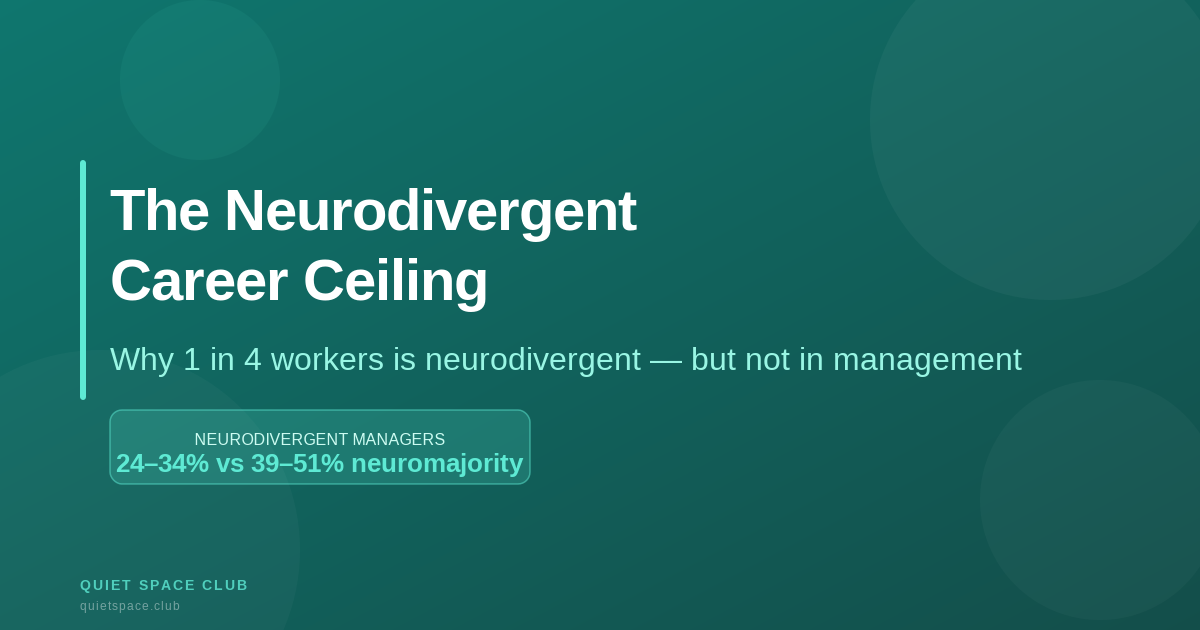
A quarter of your workforce is neurodivergent. That's not a future projection — it's what new research from Dublin City University found when it surveyed over 1,500 employees across three corporate workplaces in early 2026. One in four people self-identified or had been diagnosed as neurodivergent. Yet when researchers looked at who held management positions, neurodivergent employees were consistently and significantly underrepresented. The gap is not subtle: neurodivergent employees occupied 24–34% of managerial roles across the three organisations, compared to 39–51% for their neuromajority counterparts. This is the neurodivergent career ceiling — and in 2026, it's one of the most pressing inclusion challenges UK employers face.
Key Findings at a Glance
| Metric | Finding | Source |
|---|---|---|
| Neurodivergent employees in the workforce | 1 in 4 (25%) | DCU Institute of Education, 2026 |
| ND employees in managerial roles | 24–34% | DCU Institute of Education, 2026 |
| Neuromajority employees in managerial roles | 39–51% | DCU Institute of Education, 2026 |
| ND employees likely experiencing depression | 18.5% | DCU, using WHO-5 Well-Being Index |
| Employees saying accommodations are necessary | 80%+ | DCU Institute of Education, 2026 |
| Neurodivergent women who mask at work | 75% | Understood.org Neurodiversity at Work Survey, May 2026 |
| UK employers with a neurodiversity policy | 36% | City & Guilds Neurodiversity Index 2026 |
The Data Behind the Ceiling
The DCU research, led by Dr Aoife Brennan, Dr Laura Gormley, Dr Izzy Fox and Dr Christina O'Keeffe at the Centre for Inclusive Pedagogy, is one of the most significant corporate neurodiversity studies published this year. Surveying employees across three distinct professional service organisations, it found that the same barriers appear regardless of industry or company culture. "The same challenges arising in all three workplaces would suggest that the findings are indicative of the Irish workplace more broadly," noted report co-author Dr Laura Gormley — and given how closely Irish and UK corporate cultures align, the implications travel easily across the Irish Sea.
The management gap is the most striking headline, but the wellbeing data is arguably more urgent. 18.5% of neurodivergent employees in the study were assessed as likely experiencing significant levels of depression, based on the World Health Organisation's Well-Being Index (WHO-5). These are not people who are disengaged or struggling through a bad week — these are talented professionals experiencing a sustained wellbeing crisis at work, largely invisible to their employers. Neurodivergent employees who cannot access the right support and environment do not simply underperform. They quietly deteriorate.
Masking: The Hidden Tax on Neurodivergent Careers
One reason neurodivergent professionals reach management at lower rates is the energy cost of masking — suppressing natural behaviours and traits to conform to neurotypical workplace norms. The Understood.org Neurodiversity at Work Survey, published in May 2026, found that 75% of neurodivergent women and 69% of neurodivergent men feel pressure to mask or conform to neurotypical behaviour at work due to stigma. Masking is cognitively and emotionally exhausting. It consumes the mental bandwidth that would otherwise go into doing excellent work, building relationships, and developing the strategic visibility that typically precedes promotion.
For neurodivergent professionals who have been masking for years, the prospect of moving into a more senior, visible role can feel actively threatening rather than aspirational. More exposure means more performance, more scrutiny, more sustained effort to appear neurotypical. It is not that neurodivergent employees lack ambition — it is that the environment makes ambition feel dangerous. Workplaces that remove the need to mask, by design rather than by exception, are the ones where neurodivergent careers actually flourish.
Pro Tip
Ask your neurodivergent employees — anonymously — how much energy they spend managing how they come across versus doing their actual job. If the answer is "a lot", your culture is taxing them before the working day has even begun. Psychological safety for neurodivergent people is not just an HR goal; it is a prerequisite for retaining and promoting your most cognitively diverse talent.
The Accommodations Most Neurodivergent Employees Actually Want
The DCU study is unusually specific about what neurodivergent employees themselves prioritise when asked about workplace accommodations. Rather than expensive assistive technology or complex structural redesign, the top requests are remarkably straightforward. Hybrid working, access to quiet focus spaces, and flexible start and finish times were the three most frequently cited accommodations. Over 80% of respondents — both neurodivergent and neuromajority — agreed that specific accommodations were necessary for neurodivergent employees to succeed. This is not a minority view. It is a broad professional consensus that most organisations are still failing to act on.
The report also highlights hot-desking as a specific structural barrier. For many neurodivergent employees — particularly those with ADHD, autism, or sensory processing differences — arriving at the office without a guaranteed, consistent workspace creates immediate anxiety and cognitive overload before the working day has started. The recommendation is clear: reduce or eliminate hot-desking, or at minimum provide a designated quiet focus zone that employees can use without prior booking or formal disclosure. The neuro-friendly spaces in our directory are assessed specifically on whether they offer this kind of predictable, low-sensory environment.
Why Neuroinclusion Is a Leadership Pipeline Issue
The management gap is not just a fairness issue — it is a business risk. If neurodivergent employees represent 25% of the workforce but only 24–34% of management, organisations are systematically losing access to a significant proportion of their cognitive diversity at precisely the level where strategic decisions are made. Research consistently shows that cognitively diverse leadership teams make better decisions, identify more creative solutions, and are more resilient under pressure. Closing the neurodivergent career ceiling is not charity — it is a competitive advantage that most organisations are leaving on the table.
With only 36% of UK employers having any neurodiversity policy (City & Guilds Neurodiversity Index 2026), the structural foundations for equitable career progression simply do not exist in most organisations. When neuroinclusion depends on individuals — a sympathetic manager, a persistent HR champion — it cannot be consistently applied across a leadership pipeline. Becoming a certified neuroinclusive workspace is one way organisations can signal a structural commitment rather than a discretionary one. The NeuroIndex assessment process examines not just physical environment but policies, management culture, and career development equity.
Pro Tip
Audit your last 12 months of promotions. What percentage of people promoted to management roles were neurodivergent? If you don't know, that's a finding in itself. Promotion data disaggregated by neurodivergence is the fastest way to make the career ceiling visible — and visible problems get fixed. You cannot close a gap you have not measured.
What Employers Can Do Now
The DCU research closes with a series of practical recommendations that require no specialist budget and no external consultant. They include: providing a dedicated quiet focus space within the immediate team environment; reducing or eliminating hot-desking; switching from bright overhead lighting to dimmable or ambient alternatives; offering genuine flexibility over work schedules; and — critically — designing access to accommodations so that employees do not need to formally disclose a diagnosis to receive support. This last point matters enormously. Disclosure remains the biggest barrier to neurodivergent employees accessing support, and any system that requires disclosure first will always miss the people who need it most.
Dr Aoife Brennan, Head of the School of Inclusive and Special Education at DCU, put it plainly: "As the workplace continues to evolve, and with the advancement of new technologies, it is important that inclusion and opportunity for progression for everybody is at the heart of decision-making." The neurodivergent career ceiling is not inevitable. It is the predictable result of designing organisations around a neurotypical default — and it can be dismantled, one structural change at a time. The Quiet Space Club platform exists to help neurodivergent professionals find the workplaces that have already done this work.
What percentage of the workforce is neurodivergent?
Research from Dublin City University (2026) found that 25% of corporate employees — one in four — self-identify or have been diagnosed as neurodivergent. Commonly reported conditions included ADHD, autism, dyslexia, dyspraxia, OCD, dyscalculia, and sensory processing differences.
Why are neurodivergent employees underrepresented in management?
Multiple factors contribute, including the energy cost of masking (suppressing neurodivergent traits to conform to neurotypical norms), reduced psychological safety, lack of formal accommodation during promotion processes, and systemic gaps in management training. The DCU 2026 study found neurodivergent employees held 24–34% of managerial roles versus 39–51% for neuromajority colleagues.
What workplace accommodations do neurodivergent employees most want?
According to the DCU 2026 research, the top three accommodations requested by neurodivergent employees are hybrid working, access to quiet focus spaces, and flexible start and finish times. Over 80% of all employees — not just neurodivergent ones — agreed these accommodations were necessary for neurodivergent colleagues to succeed.
What is masking and why does it affect career progression?
Masking is the practice of suppressing neurodivergent behaviours and traits to appear neurotypical at work. It is cognitively exhausting and disproportionately affects career progression because it consumes mental energy that would otherwise go into strategic thinking, relationship-building, and visibility. The Understood.org 2026 survey found 75% of neurodivergent women and 69% of neurodivergent men feel pressure to mask at work due to stigma.
How can I find a neuro-friendly workplace that supports career development?
The Quiet Space Club directory lists certified neuro-friendly workspaces assessed against the NeuroIndex — a framework that evaluates physical environment, policy, management culture, and career development equity. Browse the <a href="/spaces/">directory</a> or learn more about how spaces are assessed via the <a href="/how-it-works/">NeuroIndex assessment process</a>.