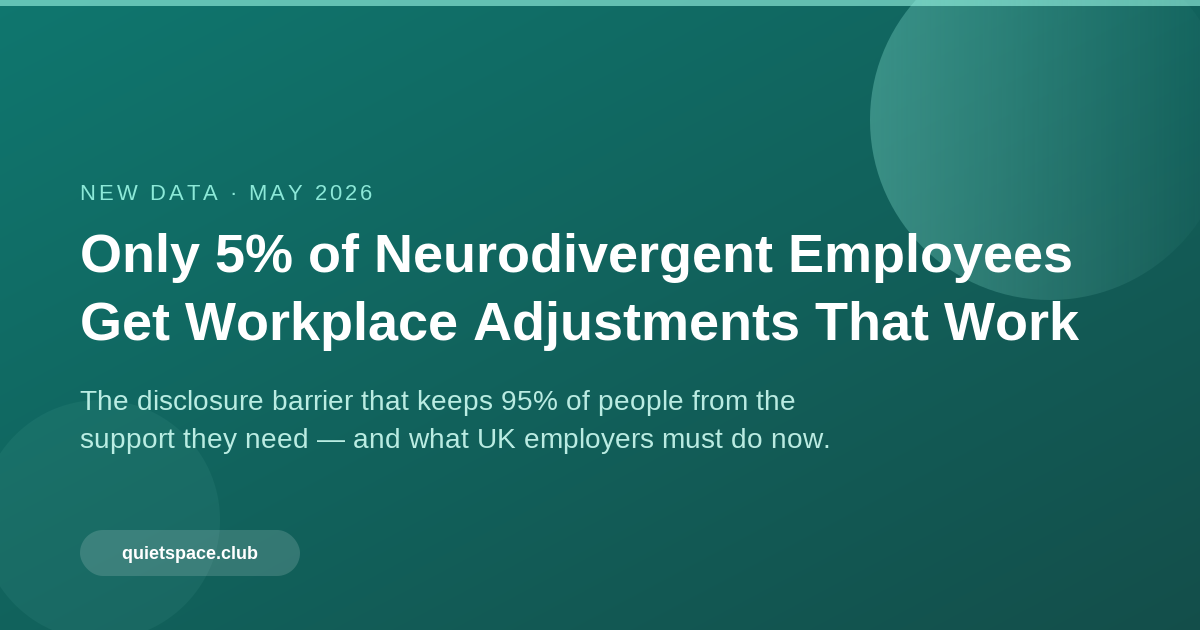
A new report published this week by NeuroBridge — one of the UK's leading neuroinclusion platforms — has landed a number that should stop every HR leader in their tracks: only 5% of neurodivergent employees have workplace adjustments that actually work for them. Of the remaining 95%, 82% have no adjustments at all, and 13% have adjustments that simply don't meet their real needs. The report, published on 28 May 2026, identifies a single root cause for this systemic failure: the requirement to disclose.
This finding lands in the same week that Understood.org's third annual Neurodiversity at Work survey revealed that 70% of neurodivergent employees worry that disclosing their neurodivergence would negatively affect their career — up sharply from 59% in 2024. Together, these two datasets paint an urgent picture: organisations have built well-meaning adjustment processes that the very people they're designed to support are choosing not to use. Understanding why — and what the alternative looks like — is one of the most important conversations in neuroinclusion right now.
Key findings at a glance
| Statistic | Figure | Source |
|---|---|---|
| Neurodivergent employees with no workplace adjustments | 82% | NeuroBridge White Paper 2025 |
| Have adjustments, but they don't work | 13% | NeuroBridge White Paper 2025 |
| Have adjustments that genuinely work | 5% | NeuroBridge White Paper 2025 |
| Fear career impact from disclosing neurodivergence | 70% | Understood.org, May 2026 |
| Didn't disclose due to fear of career impact | 73% | NeuroBridge White Paper 2025 |
| Neurodivergent women who feel pressure to mask at work | 75% | Understood.org, May 2026 |
| UK employers with a neurodiversity policy | 36% | City & Guilds Foundation 2026 |
| Neurodiversity-related UK employment tribunals (4-year increase) | +164% | NeuroBridge 2026 |
Why disclosure is the barrier, not the solution
The standard workplace adjustment pathway in most UK organisations follows a logical sequence: an employee discloses a condition or difficulty to their manager or HR, a referral is made, adjustments are discussed and agreed. On paper, it's a clear process. In practice, it's a door that most neurodivergent people look at, weigh up the risks, and walk past.
NeuroBridge's new analysis found that 73% of neurodivergent employees who haven't received adjustments cited fear of career impact as the reason they haven't disclosed. This isn't paranoia — it's a rational calculation. Many neurodivergent employees have observed, or experienced first-hand, that disclosed conditions can surface in promotion reviews, project assignments and the invisible judgements managers make about who is "ready" for more. The disclosure doesn't stay in the HR process. It follows the person.
The result is a system in which the most significant predictor of whether a neurodivergent employee receives support is not the severity of their need, but their willingness to accept the reputational risk that comes with asking for it. For organisations, this means the vast majority of their investment in adjustment processes is simply not reaching the people it was designed for.
Pro Tip
If your organisation's adjustment uptake is below 20%, the process is unlikely to be the problem. Audit how many neurodivergent employees feel psychologically safe enough to use it — that number will tell you far more. Consider running an anonymous pulse survey specifically on this question before redesigning any process.
The self-understanding gap nobody talks about
There is a second barrier that sits upstream of disclosure and rarely gets named directly. Even if a neurodivergent employee wanted to request an adjustment, many wouldn't know what to ask for. This is not a knowledge gap about policy — it's a self-understanding gap. Neurodivergent individuals often have a clear sense that something about how they work is different, but lack a framework for translating that into a specific, actionable request to a manager or HR partner.
According to Understood.org's 2026 survey, 70% of neurodivergent employees have no idea what accommodations they are entitled to — up from 60% in 2024 — and 60% don't know who to talk to in order to request one. These numbers have been rising year-on-year even as general neurodiversity awareness has increased. Awareness of neurodiversity as a concept is not the same as knowing how to navigate a workplace system designed for neurotypical communication styles.
NeuroBridge's research suggests that effective workplace adjustments depend on self-understanding first. Before an individual can articulate what they need, they need a language for how they actually process information, manage focus, recover energy and respond to different working conditions. That language is what most adjustment processes skip entirely — they assume the individual already knows their needs and simply need a process to get them met.
What disclosure-free support looks like in practice
The shift that NeuroBridge is advocating for — and that a growing number of UK employers are beginning to implement — is moving adjustment support from a disclosure-triggered process to a self-directed one. Instead of requiring an individual to identify a condition, approach a manager or HR partner, and make a case for support, the individual starts with a private self-assessment that explores how they work rather than what is "wrong" with them.
Critically, in disclosure-free frameworks, the individual owns their profile. They decide what information, if any, reaches their manager or HR. The organisation receives aggregated, anonymised insight — which adjustments are most requested, where uptake is low, what themes are emerging across teams — without ever seeing individual records. The signal HR has long been missing arrives in a form that respects the very privacy that made the traditional system unusable.
This approach also benefits employees who aren't formally neurodivergent. Anyone can use a self-directed tool to understand the rhythm of their own attention, focus and recovery. Designing for the sharpest cognitive challenge raises the floor for everyone — a principle familiar to anyone who has worked in a neuro-friendly workspace and found that the quiet, lower-sensory environment benefits the whole team, not just neurodivergent members.
Pro Tip
When reviewing your adjustments process, ask whether it requires disclosure <em>before</em> support begins. If yes, pilot a diagnosis-agnostic self-assessment tool alongside your existing process. Track uptake separately for six months. The difference in engagement will give you the evidence you need to make the case for a broader redesign.
The growing legal risk of inaction
The business case for addressing this is sharpened considerably by the legal context. Neurodiversity-related employment tribunals in the UK have increased by 164% over the last four years, according to NeuroBridge's 2026 analysis. Many of these cases do not arise from malicious intent — they arise from a failure to make reasonable adjustments, inconsistent application of policy, or a lack of understanding at line manager level. As more neurodivergent employees identify their needs later in life and feel more confident self-advocating, the cost of running an adjustment process that only reaches 5% of those who need it is rising fast.
The Equality Act 2010 places a duty on employers to make reasonable adjustments for employees with disabilities, and ADHD, autism, dyslexia and other neurodivergent conditions are regularly found to meet the legal definition of disability by employment tribunals. Organisations that can demonstrate a proactive, accessible adjustment process — one that doesn't rely on a single gate of disclosure — are in a far stronger position than those whose policy exists on paper but is barely used. You can learn more about how the NeuroIndex assessment works and what it measures in practice.
What neuro-friendly workspaces have to do with it
Physical environment is often the adjustment that neurodivergent employees most urgently need, and the one they are least likely to receive through a disclosure-gated process. Sensory overwhelm, open-plan noise, unpredictable lighting and a lack of quiet retreat space are among the most commonly cited barriers to consistent performance — yet requesting an environmental adjustment feels even more exposing than requesting extra time or written instructions, because it involves changing a shared space.
This is precisely why the growth of certified neuro-friendly workspaces matters. When a space is independently assessed and certified as neuro-friendly — with quiet zones, sensory-considered design, and predictable environment as standard — it removes the need for any individual to flag their needs. The space works for neurodivergent brains by design, not by negotiation. For neurodivergent professionals who are self-employed, freelance, or working in offices that don't yet meet their needs, access to a verified neuro-friendly workspace is itself a form of adjustment — one that doesn't require disclosing anything to anyone. Workspace providers can find out more about the NeuroIndex certification process.
Do neurodivergent employees have a legal right to workplace adjustments in the UK?
Under the Equality Act 2010, employers have a duty to make reasonable adjustments for employees whose neurodivergent condition meets the legal definition of disability — which ADHD, autism, dyslexia and dyspraxia frequently do in employment tribunal decisions. The adjustment must be reasonable given the employer's size and resources, but courts have found that low-cost adjustments such as written instructions, flexible start times and quiet working space are almost always reasonable. Employees do not need a formal diagnosis to request adjustments, though having one can strengthen their position.
Can an employer require disclosure before providing workplace adjustments?
Legally, an employer cannot compel an employee to disclose a medical condition as a condition of receiving adjustments. In practice, however, most adjustment processes are designed in a way that makes disclosure feel necessary. Employers are increasingly encouraged to build proactive, disclosure-optional frameworks that allow employees to access support without requiring them to label themselves or enter a formal process.
Why are workplace adjustment uptake rates so low?
Research consistently points to fear of stigma and career impact as the primary barrier. NeuroBridge's 2025 audit data found that 73% of neurodivergent employees who hadn't received adjustments cited fear of career impact as the reason for not disclosing. A secondary barrier is self-understanding — many neurodivergent employees aren't sure what adjustments to ask for, or what they are entitled to, making the process feel inaccessible even before the disclosure question arises.
What is a diagnosis-agnostic adjustment process?
A diagnosis-agnostic approach removes the requirement for an employee to have a formal diagnosis before accessing adjustment support. Instead of focusing on a condition or label, it focuses on how the individual works — their cognitive preferences, energy patterns, sensory needs and communication style — and uses that information to identify practical adjustments. This approach is more accessible, reduces stigma, and tends to achieve significantly higher uptake than traditional disclosure-gated processes.
How can neurodivergent employees access neuro-friendly workspaces without disclosing to their employer?
Neuro-friendly workspaces listed on <a href="/">Quiet Space Club</a> can be accessed independently by any professional — no employer involvement or disclosure is required. Spaces are certified through the NeuroIndex assessment process, which evaluates sensory environment, quiet provision, lighting, acoustics and flexibility. Neurodivergent professionals can use the directory to find and book a space that works for their cognitive needs without any requirement to explain why to anyone.