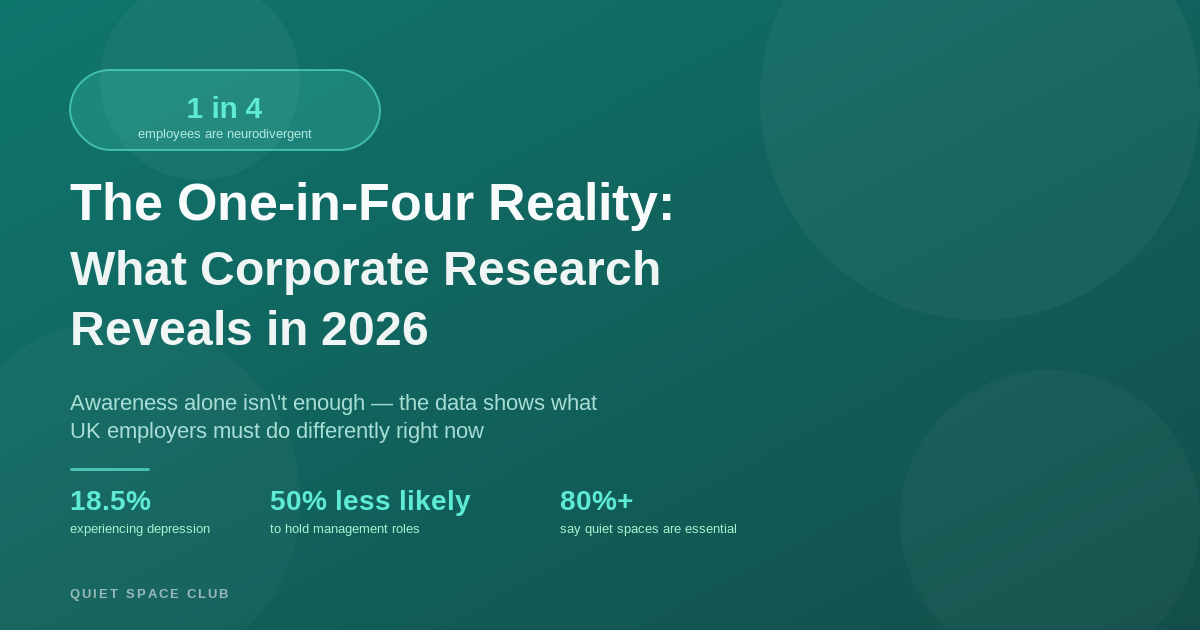
One in four corporate employees self-identify or have been diagnosed as neurodivergent. That is the headline finding from new research published by Dublin City University's Institute of Education, which surveyed more than 1,500 employees across three distinct corporate workplaces. The figure is striking — and it is almost certainly an undercount, given the well-documented reluctance many neurodivergent professionals have around formal disclosure. Combined with data from the City & Guilds Neurodiversity Index 2026 and the NeuroBridge State of Neurodiversity report, the picture that emerges in mid-2026 is one of enormous untapped potential being systemically suppressed by workplace environments that were never designed with neurodivergent people in mind. The research has direct implications for every HR professional, line manager, and workspace provider in the UK — and for the neurodivergent professionals trying to do their best work inside those organisations.
Key Findings at a Glance
| Metric | Finding | Source |
|---|---|---|
| Corporate employees who are neurodivergent | 1 in 4 (25%) | DCU Institute of Education, 2026 |
| Neurodivergent employees likely experiencing significant depression | 18.5% | DCU / WHO-5 Wellbeing Index, 2026 |
| Neurodivergent employees in management roles (range across workplaces) | 24%–34% | DCU Institute of Education, 2026 |
| Neuromajority employees in management roles (range) | 39%–51% | DCU Institute of Education, 2026 |
| Employees (all) saying accommodations are necessary for neurodivergent success | 80%+ | DCU Institute of Education, 2026 |
| Top accommodations identified by neurodivergent employees | Hybrid working, quiet spaces, flexible hours | DCU Institute of Education, 2026 |
| Gap between employer neuroinclusion confidence and employee experience | 30–35 percentage points | City & Guilds Neurodiversity Index 2026 |
| Neurodivergent professionals more likely to experience burnout vs neurotypical peers | 2x | NeuroBridge State of Neurodiversity 2026 |
The Scale of Neurodivergence in UK Workplaces
The DCU research surveyed employees across three corporate workplaces providing distinct professional services, making the consistency of its findings particularly significant. Autism, ADHD, dyspraxia, OCD, dyslexia, dyscalculia, sensory processing differences, anxiety, and depression were among the most commonly reported neurodivergences. With 25% of respondents identifying as neurodivergent, the implications are profound: in an organisation of 200 people, approximately 50 employees are navigating working life through a brain that processes the world differently. In an organisation of 2,000, that is 500 people — a significant proportion of any workforce, and one whose needs are still routinely overlooked or misunderstood. Commonly cited UK estimates suggest 1 in 7 people are neurodivergent, but the DCU data — using self-identification and diagnosis rather than assumptions — suggests the actual proportion in corporate settings may be considerably higher.
This matters because organisations are still largely designing their workplaces, cultures, and progression pathways for a neurotypical majority that may not exist in the proportions assumed. The NeuroIndex methodology used to assess spaces listed on Quiet Space Club is grounded in this same reality: that neuro-friendly design cannot be an afterthought, because neurodivergent people are not a small edge case. They are a substantial and growing proportion of every UK workforce.
The Management Gap: Hidden in Plain Sight
The most structurally important finding in the DCU report is the disparity in management representation. Across the three corporate workplaces surveyed, between 24% and 34% of neurodivergent employees held managerial positions, compared with 39% to 51% of their neuromajority colleagues. That is a gap of up to 17 percentage points — a consistent, systematic underrepresentation that cannot be explained by capability or ambition. It reflects instead the cumulative effect of workplaces that were not built to support neurodivergent people's progression: the executive presence expectations that favour neurotypical communication styles, the informal networking that disadvantages people who find unstructured social interaction exhausting, the performance management systems that focus on process over output. Dr Aoife Brennan, head of the School of Inclusive and Special Education at DCU's Institute of Education, put it directly: "The findings reveal that employees who are neurodivergent are less likely to hold managerial positions, which reinforces the need for employers to consider inclusivity in their strategising so that all employees have the same opportunity to progress and grow in their careers."
Pro Tip
If your organisation doesn't know the neurodivergent representation at each level of its hierarchy, it can't address the management gap. Before building a neuroinclusion strategy, audit your people data by seniority — even anonymised self-identification surveys give you the baseline you need. The gap is almost always larger than leaders expect.
Wellbeing: The Hidden Cost of Inadequate Support
The DCU research used the World Health Organisation's WHO-5 Wellbeing Index to assess employee mental health. The results are stark: 18.5% of neurodivergent employees were assessed as likely experiencing significant levels of depression — compared with considerably lower rates among their neuromajority colleagues. This finding sits alongside data from the NeuroBridge State of Neurodiversity in the Workplace 2026 report, which found that neurodivergent professionals are twice as likely as their neurotypical peers to experience high symptoms of burnout, and that more than half have taken absence from work due to workplace-related challenges. These are not abstract statistics. They represent a significant proportion of every organisation's workforce quietly struggling — often without disclosure, often without support, and often while simultaneously masking their neurodivergent traits in order to meet neurotypical expectations. The financial and human cost is substantial. And much of it is preventable.
The City & Guilds Neurodiversity Index 2026 adds another layer to this picture: 41% of neurodivergent employees report being impacted by workplace challenges on most days. That figure has not improved despite years of rising employer confidence in their neuroinclusion efforts. The confidence gap — with employers rating their own neuroinclusion efforts 30 to 35 percentage points higher than neurodivergent employees rate the same efforts — suggests that most organisations are measuring their intentions rather than their impact. Workspace providers who want to attract neurodivergent professionals are increasingly aware of this: it is not enough to label a room as a quiet zone. The design, the consistency, and the culture around that space all matter.
What Neurodivergent Employees Actually Need
One of the most practically useful elements of the DCU research is its identification of the specific accommodations that neurodivergent employees themselves prioritise. Over 80% of all survey respondents — neurodivergent and neuromajority alike — agreed that specific accommodations were necessary for neurodivergent employees to succeed at work. The top three accommodations identified by neurodivergent employees were hybrid working, access to quiet spaces, and flexible start and finish times. These are not expensive or operationally complex to provide. They are, in the language of the DCU report, "small changes" that "have a large impact." The research team, which included Dr Laura Gormley, Dr Izzy Fox, and Dr Christina O'Keeffe alongside Dr Brennan, offers concrete guidance: provide a recognised quiet focus space within team environments, minimise or eliminate hot-desking, reduce reliance on bright overhead lighting, and give employees genuine agency over their own schedules.
This is precisely what Quiet Space Club's directory of certified neuro-friendly workspaces is designed to support: for neurodivergent professionals who need a space that works with their brain rather than against it. Not every employer can provide a dedicated quiet room — but those that partner with spaces in the Quiet Space Club network can offer their neurodivergent employees access to assessed, neuro-friendly environments whenever they need them. It is one of the most straightforward ways to move from awareness to the action that the DCU research identifies as the missing piece.
Pro Tip
Hot-desking is particularly harmful for many neurodivergent employees, who depend on environmental predictability and personalised sensory control to regulate focus and manage anxiety. If a full policy change isn't immediately possible, begin by designating at least one consistent, bookable quiet zone on each floor — and communicate its purpose clearly to the whole team, not just neurodivergent individuals. Reducing stigma around using it matters as much as providing it.
From Awareness to Action: The Imperative for 2026
The title of the DCU report captures the central challenge of neurodivergence in UK workplaces right now: "Awareness is one of the big things, but then after awareness, it's action, right?" This question — posed by a research participant, not a consultant — is the most important one any HR leader or senior manager should be asking in 2026. Awareness of neurodiversity has risen substantially. Training programmes exist. Policies are being written. But as the City & Guilds Neurodiversity Index, the NeuroBridge report, and now the DCU research all show in their different ways, the delivery gap has not closed. Neurodivergent employees are still less likely to be promoted. They are still more likely to be experiencing depression. They are still waiting months for workplace adjustments. And they are still working in environments — physical environments — that were designed without them in mind. The research from DCU is clear that small, targeted changes to the physical and cultural working environment produce significant wellbeing and productivity gains, not just for neurodivergent employees but for everyone. That is not a side note. It is the business case.
How many employees in UK corporate workplaces are neurodivergent?
New research from Dublin City University (2026), surveying over 1,500 corporate employees, found that 1 in 4 (25%) self-identify or have been diagnosed as neurodivergent. This is higher than the commonly cited 1-in-7 figure and likely reflects both rising rates of diagnosis and increasing willingness to self-identify in workplace research.
What are the top workplace accommodations neurodivergent employees need?
The DCU 2026 research found that neurodivergent employees prioritise three accommodations above all others: hybrid working flexibility, access to dedicated quiet spaces, and flexible start and finish times. Over 80% of all employees surveyed — not just neurodivergent respondents — agreed that specific accommodations are necessary for neurodivergent colleagues to succeed.
Are neurodivergent employees less likely to be managers?
Yes, significantly so. The DCU research found that 24%–34% of neurodivergent employees held managerial positions across the workplaces surveyed, compared with 39%–51% of neuromajority employees. This gap of up to 17 percentage points reflects systemic barriers to progression rather than any difference in capability.
What is the wellbeing impact on neurodivergent employees at work?
The DCU research found that 18.5% of neurodivergent employees were likely experiencing significant levels of depression, based on the WHO-5 Wellbeing Index. Separately, NeuroBridge's 2026 report found neurodivergent professionals are twice as likely as neurotypical peers to experience high levels of burnout, and more than half have taken absence from work due to workplace-related challenges.
How can workspace providers support neurodivergent professionals?
The research points to specific design and policy choices: eliminating or minimising hot-desking, providing quiet focus zones that all employees can access without stigma, reducing bright overhead lighting, and supporting flexible working patterns. Quiet Space Club's NeuroIndex assessment evaluates all of these factors when certifying neuro-friendly spaces. You can explore certified spaces in the directory or learn how certification works for workspace providers.