For years, the business case for neuroinclusion was built on moral arguments — it's the right thing to do, it reflects our values, it helps with DEI commitments. In 2026, those arguments remain valid, but they're no longer the most compelling ones in the room. A growing body of data from UK employers — ranging from professional services giants to broadcasters and pharmaceutical companies — now makes the financial case with striking clarity. Neuroinclusion is not a cost centre. It is a performance lever. And organisations that are still treating it as optional charity are leaving substantial, measurable value on the table. This piece draws on the most significant data published by and about UK employers in 2026 to make that case as concretely as the evidence allows — and to highlight what's still going wrong in the gap between policy and practice. For neurodivergent professionals seeking genuinely supportive environments in the meantime, the Quiet Space Club directory of certified neuro-friendly workspaces provides a practical starting point.
Key Takeaways
| Finding | Detail |
|---|---|
| EY: neurodiverse teams 1.2–1.4x more productive | EY internal data, reported in 2026 UK employer analysis by Fertifa |
| SAP: single ND employee saved £31m | One neurodivergent employee developed a technical fix worth an estimated £31 million — SAP, reported 2026 |
| Deloitte: neurodiverse teams solve problems 3x faster | Deloitte 2025/26 research; neuroinclusive orgs also 75% more likely to get ideas to product |
| HSBC: every £1 invested returns up to £4 | Industry benchmark from HSBC Access Ability programme, via Fertifa 2026 |
| GSK: saves £6,804 per employee annually | Via specialist neuroinclusive tools for researchers with ADHD and autism — Fertifa 2026 |
| 25% of corporate employees are neurodivergent | Dublin City University survey of 1,500+ workers across three organisations, January 2026 |
| Only 40% of neurodivergent employees feel supported | Same DCU 2026 survey; 80% need accommodations but only 25% request them |
| 164% rise in neurodiversity employment tribunals | Over four years — UK tribunal data, 2026 |
The Scale of the Opportunity Most Employers Are Missing
The starting point for any business case is understanding the size of the population it concerns. Many UK employers still significantly underestimate the proportion of their workforce that is neurodivergent — largely because disclosure rates remain low and diagnosis waiting lists run into years. A landmark survey published in January 2026 by Dublin City University's Institute of Education — covering more than 1,500 employees across three different corporate organisations — found that 25% of employees (one in four) were neurodivergent, based on self-identification or formal diagnosis. This figure is substantially higher than many HR teams assume, and it has direct implications for how organisations think about the scale of their neuroinclusion opportunity.
The same DCU research found that of those neurodivergent employees, only 40% feel supported at work. Eighty per cent say they need accommodations to do their jobs effectively, yet only 25% actually request them. The gap between need and request is not a sign that the needs are modest — it is a signal of disclosure anxiety, limited knowledge of entitlements, and a justified fear of how disclosure will be received. A February 2026 paper published by iOH (The Association of Occupational Health and Wellbeing Professionals) — drawing on research from Birkbeck's UK Research Centre for Neurodiversity at Work — found that 65% of neurodivergent employees fear discrimination from management, and 55% from colleagues. When the majority of a group fears that asking for support will make things worse, the absence of requests should not be misread as an absence of need.
A further data point underscores the urgency. Analysis by PAM Group of 135,000 Occupational Health referrals between April 2024 and March 2025 found that neurodivergence had become the third leading reason for OH referral, behind only mental health and musculoskeletal conditions. This is not a niche issue. It is a mainstream workforce health challenge — and the data suggests most organisations are encountering it reactively, in crisis, rather than addressing it proactively through design.
What Leading UK Employers Are Actually Reporting
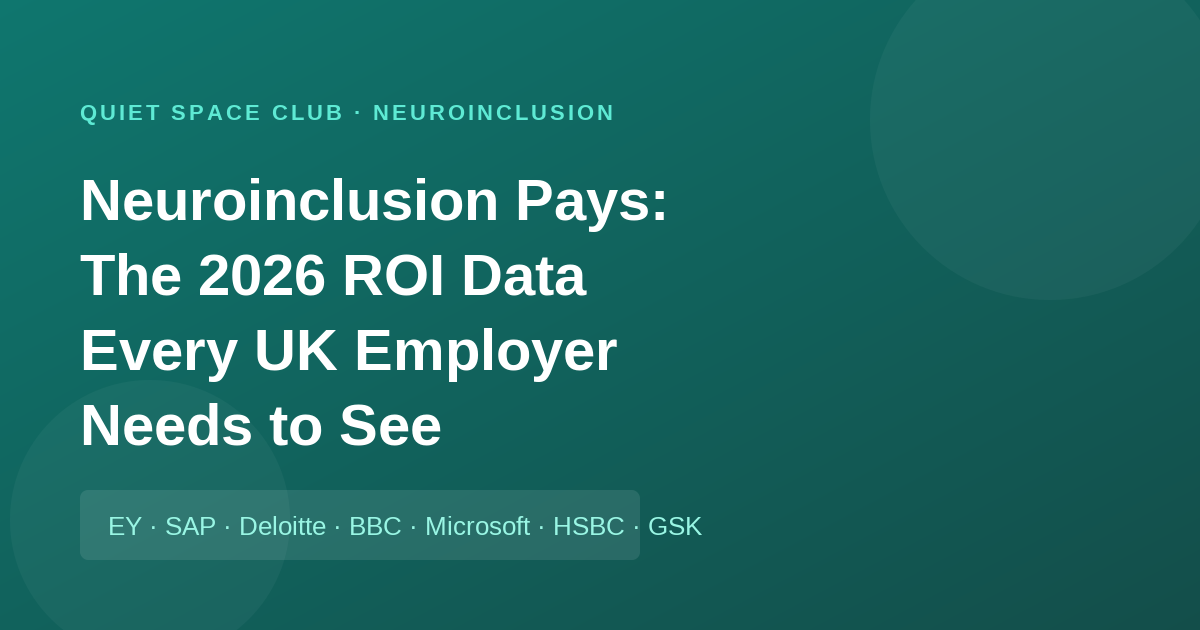
The most compelling element of the 2026 business case is no longer theoretical — it comes from internal reporting by major UK organisations that have made meaningful investments in neuroinclusion and measured the results. A 2026 analysis by employee health benefit provider Fertifa compiled data from thirteen UK companies, yielding some of the most concrete employer-reported figures available.
| Organisation | Neuroinclusion Investment | Reported Outcome |
|---|---|---|
| EY UK | Dedicated neurodiversity hubs in cybersecurity and data analytics | Neurodiverse teams 1.2–1.4x more productive than non-neurodiverse teams |
| SAP UK | Targeted neurodiversity hiring and support programme | One ND employee saved an estimated £31m; 90% first-year retention rate |
| Microsoft UK | Structured neurodiversity hiring programme | 90% retention rate for programme hires — saving millions annually in recruitment costs |
| Deloitte UK | Neuroinclusive team design (2025/26 research) | 75% more likely to see ideas progress to product; neurodiverse teams solve complex problems 3x faster |
| BBC | Flexible and remote working adjustments (Cambridge ThinkLab collaboration) | 75% of neurodivergent employees performed better as a direct result |
| HSBC | Access Ability programme, specialist support tools | Every £1 invested in specialist support returns up to £4 via reduced absenteeism and improved productivity |
| GSK | Neuroinclusive specialist tools for ADHD and autism researchers | Average saving of £6,804 per employee annually |
Source: Fertifa, "The ROI of Neurodiversity Workplace Support: Thirteen UK-Based Companies Leading the Way in 2026". Published February 2026, updated May 2026.
These figures are striking in their specificity. SAP's 90% first-year retention rate in an industry where average tech sector retention is markedly lower represents substantial savings in recruitment and onboarding costs alone — quite apart from the £31 million attributed to a single employee's contribution. Microsoft's equivalent 90% retention figure from its neurodiversity programme suggests this is not an outlier but a pattern: when neurodivergent employees are recruited and supported effectively, they stay. The cost of replacing a skilled employee typically runs to between 50% and 200% of annual salary — which means that neuroinclusion's retention impact alone can deliver a significant, calculable return.
Pro Tip
If you're building the internal business case for neuroinclusion at your organisation, start by calculating your current cost of attrition for neurodivergent employees — including recruitment fees, onboarding time, and productivity loss during transition. Most organisations find this number is significantly higher than the cost of proactive, structured adjustment programmes. The <a href="https://www.acas.org.uk/why-uk-businesses-must-prioritise-neuroinclusion" target="_blank" rel="noopener noreferrer">Acas guidance on prioritising neuroinclusion</a> provides a practical framework for making this case to senior leadership.
The Innovation Dividend: What Neurodivergent Thinking Brings
Beyond retention and productivity, the 2026 data reinforces a long-standing finding in neurodiversity research: neurodiverse teams are measurably stronger on innovation. Deloitte's most recent research found that neuroinclusive organisations are 75% more likely to see ideas progress from concept to product — and that neurodiverse teams solve complex problems three times faster than homogeneous groups. These are not marginal gains. They are the kind of performance differences that, in competitive markets, translate directly into commercial advantage.
The cognitive science behind this is well-established. Research from Birkbeck's UK Research Centre for Neurodiversity at Work — drawing on surveys of over 1,100 people including 127 employers — found that over 80% of neurodivergent employees demonstrate hyperfocus, 78% high creativity, 75% innovative thinking, and 71% exceptional detail processing. These cognitive strengths are not incidental to neurodivergence — they are frequently its expression. The same neurological wiring that creates challenges in sensory-hostile open-plan offices or under rigid communication norms also generates the pattern recognition, systems thinking, and lateral problem-solving that organisations increasingly pay premium salaries to find in neurotypical candidates. Neuroinclusion, done well, means accessing those strengths at scale.
The Cost of Getting It Wrong
The ROI case for neuroinclusion is not only about the gains from investment — it is equally about the costs of failure. And those costs are now measurable, significant, and rising. The NeuroBridge State of Neurodiversity in the Workplace 2026 report found that neurodivergent professionals are twice as likely to experience high symptoms of burnout compared to neurotypical peers. More than half (51%) have taken time off work specifically because of workplace challenges — not because of their neurodivergence itself, but because their environment and management were not adapted to their needs. Almost three-quarters (73%) are currently experiencing poor mental health at work. These are not abstract welfare statistics. They are direct drivers of absenteeism, presenteeism, and attrition — all of which carry measurable cost.
The legal cost trajectory adds a further dimension. Neurodiversity-related employment tribunal claims in the UK have increased by 164% in the last four years, with payouts ranging from tens of thousands to several million pounds. In the majority of cases, the underlying failure is not malicious intent but a failure to make reasonable adjustments — adjustments that, had they been made, would have cost a fraction of the resulting legal liability. Under the Equality Act 2010, conditions including ADHD, autism, dyslexia, and dyspraxia frequently qualify as disabilities, triggering the reasonable adjustment duty regardless of whether an employee holds a formal diagnosis. Organisations that have not built systematic neuroinclusion into their HR and operational frameworks are carrying a legal exposure that grows with every new tribunal precedent.
- <strong>Absenteeism cost</strong> — 51% of neurodivergent employees have taken time off due to workplace challenges; each absence episode carries direct and indirect cost
- <strong>Burnout and attrition</strong> — 2x burnout rate means higher turnover; replacing a skilled neurodivergent employee typically costs 50–200% of annual salary
- <strong>Tribunal liability</strong> — 164% rise in neurodiversity-related employment tribunals; payouts range from tens of thousands to several million pounds
- <strong>Productivity loss from presenteeism</strong> — 90% of employees with ADHD report work errors, conflicts, or working extra hours due to unmanaged symptoms
- <strong>Innovation deficit</strong> — neurodiverse teams solve problems 3x faster (Deloitte); organisations without neuroinclusion forfeit this competitive advantage
The HSBC Formula: Every £1 Returns Up to £4
Perhaps the single most useful figure for HR professionals making the internal investment case is HSBC's reported return on neuroinclusion investment: every £1 invested in specialist neurodivergent support returns up to £4 through reduced absenteeism and increased productivity. This benchmark — drawn from HSBC's own Access Ability programme analysis and corroborated by broader industry research — provides a concrete multiplier for business case modelling. For a team of ten neurodivergent employees, an investment of £10,000 in specialist support (including tools, coaching, and reasonable adjustments) projects to a return of up to £40,000 in reduced sick leave and improved output. GSK's reported figure of £6,804 average annual saving per employee from neuroinclusive tools provides a complementary point of reference from a different sector.
Importantly, many of the most impactful adjustments carry minimal direct cost. Written communication summaries instead of verbal-only briefings, consistent desk locations rather than hot-desking, flexible start times to avoid peak commute sensory overload, access to noise-cancelling headphones or quiet focus spaces — these are organisational choices, not capital expenditure. The UK Government's Access to Work scheme also provides grants of up to £66,000 per year to fund assistive technology, coaching, and specialist support for eligible neurodivergent employees — substantially reducing the direct cost to employers of many structured interventions.
Pro Tip
When calculating neuroinclusion ROI for your board or senior leadership, use three line items: (1) <strong>Avoided tribunal cost</strong> — average UK employment tribunal settlement plus legal costs, weighted by your tribunal risk given current adjustment practices; (2) <strong>Reduced attrition cost</strong> — estimated replacement cost per neurodivergent leaver, multiplied by estimated number preventable with structured support; (3) <strong>Productivity gain</strong> — EY's 1.2–1.4x productivity multiplier applied to neurodivergent headcount percentage. Most teams find the combined figure dramatically exceeds the cost of a structured neuroinclusion programme. Workspace providers who want to make their spaces part of that ROI story can explore the <a href="/workspace-providers/">NeuroIndex certification process here</a>.
What the 2026 Data Says Still Needs to Change
The ROI data is compelling — but it exists against a backdrop of stubborn structural failure that the same 2026 evidence base makes equally clear. The City & Guilds Foundation Neurodiversity Index 2026 — now in its fourth year — found that while employer confidence in their own neuroinclusion provision has risen, the lived experience of neurodivergent employees has simultaneously worsened. Neurodivergent staff are reporting slower access to adjustments, lower psychological safety, and increased exposure to microaggressions, even as their employers feel better about what they're doing. The gap between organisational self-perception and employee experience is widening, not closing.
Only 36% of UK employers currently have a formal neurodiversity policy. Fewer than four in ten include neurodiversity in their DEI strategy at all. And 56% of managers admit they lack the knowledge and confidence to support neurodivergent colleagues effectively, according to the NeuroBridge 2026 report — despite the fact that over 60% of neurodivergent employees say their line manager is their first point of call when they need support. The organisations leading the way on neuroinclusion ROI are not achieving those returns through policy documents. They are achieving them through operational commitment: structured hiring programmes, specialist support systems, genuine physical workspace adaptation, and manager capability building that goes far beyond a single e-learning module.
For neurodivergent professionals who cannot wait for their employer's neuroinclusion strategy to mature, the physical workspace remains a critical factor. Sensory-hostile open-plan offices are not a neutral baseline — they actively undermine performance, wellbeing, and retention. The NeuroIndex assessment process provides an evidence-based framework for evaluating whether a workspace genuinely meets neurodivergent needs, not just claims to. And the Quiet Space Club certified directory connects neurodivergent professionals with workspaces that have been rigorously assessed against those criteria — providing an immediate, practical option while employer-wide change moves more slowly than many need it to.
What is the strongest financial argument for neuroinclusion for a UK employer?
The strongest arguments combine the retention ROI (replacing a skilled neurodivergent employee costs 50–200% of annual salary, and structured support programmes at SAP and Microsoft achieve 90% first-year retention), the productivity uplift (EY reports neurodiverse teams are 1.2–1.4x more productive), and the avoided tribunal liability (neurodiversity-related claims in the UK have risen 164% in four years). HSBC's reported benchmark — every £1 invested in specialist support returns up to £4 — provides a single-figure multiplier for modelling. Most organisations find the combined projected return substantially exceeds the cost of a structured neuroinclusion programme.
How much does neuroinclusion actually cost UK employers?
Many of the most impactful adjustments — consistent desk locations, written communication summaries, flexible scheduling, quiet zones — cost very little. For technology and specialist coaching, the UK's Access to Work scheme provides grants of up to £66,000 per year per eligible employee, substantially reducing the cost to employers. GSK reports average annual savings of £6,804 per employee from specialist neuroinclusive tools — meaning the tools effectively pay for themselves. The organisations with the strongest reported ROI are not necessarily those who spent the most; they are those who invested thoughtfully and measured outcomes systematically.
What proportion of the UK workforce is neurodivergent?
Estimates range from 15% to 20% of the broader working-age population (Acas guidance, 2026). A January 2026 Dublin City University survey of over 1,500 employees across three corporate organisations found that 25% (one in four) identified as neurodivergent based on self-identification or formal diagnosis. Many employers underestimate this figure because disclosure rates are low — 70% of neurodivergent employees in the UK worry that disclosing their condition will negatively affect them at work (Understood.org, May 2026). The actual neurodivergent population in most workforces is almost certainly higher than HR records suggest.
Which UK companies have reported the best outcomes from neurodiversity programmes?
EY, SAP, Microsoft, Deloitte, BBC, HSBC, and GSK have all published or reported measurable outcomes from structured neuroinclusion investments. Highlights include SAP's 90% first-year retention rate and a single employee's technical contribution saving an estimated £31m; EY's neurodiverse teams performing 1.2–1.4x more productively; Deloitte's finding that neuroinclusive organisations solve complex problems three times faster; and HSBC's reported £4 return for every £1 invested in specialist neurodivergent support. These outcomes are detailed in Fertifa's 2026 analysis of thirteen UK companies.
Where can neurodivergent professionals find workspaces that support their performance?
The <a href="/spaces/">Quiet Space Club directory</a> lists certified neuro-friendly workspaces across the UK, each assessed against evidence-based criteria covering sensory environment, acoustic quality, lighting flexibility, and cognitive accessibility. For professionals whose employer's office does not yet meet their needs — a common situation while organisational neuroinclusion strategies develop — a certified co-working space can serve as a practical reasonable adjustment. In some cases, costs may be fundable through the Access to Work scheme. Workspace providers who want to attract neurodivergent professionals and contribute to their clients' neuroinclusion ROI can apply for <a href="/workspace-providers/">NeuroIndex certification here</a>.