For the fourth consecutive year, the City & Guilds Foundation has published its Neurodiversity Index in partnership with Do-IT Solutions — and the 2026 edition lands with an uncomfortable headline: awareness of neurodiversity in UK workplaces is at an all-time high, yet the lived experience of neurodivergent employees has not kept pace. If anything, the gap is widening. Employers feel increasingly confident in their neuroinclusion efforts. Neurodivergent employees increasingly disagree. This is not a minor discrepancy — it is a structural failure that costs organisations talent, productivity, legal exposure, and trust. And it is now, for the first time, rigorously documented at scale across the UK and Ireland.
Key Findings at a Glance
| Metric | Finding | Source |
|---|---|---|
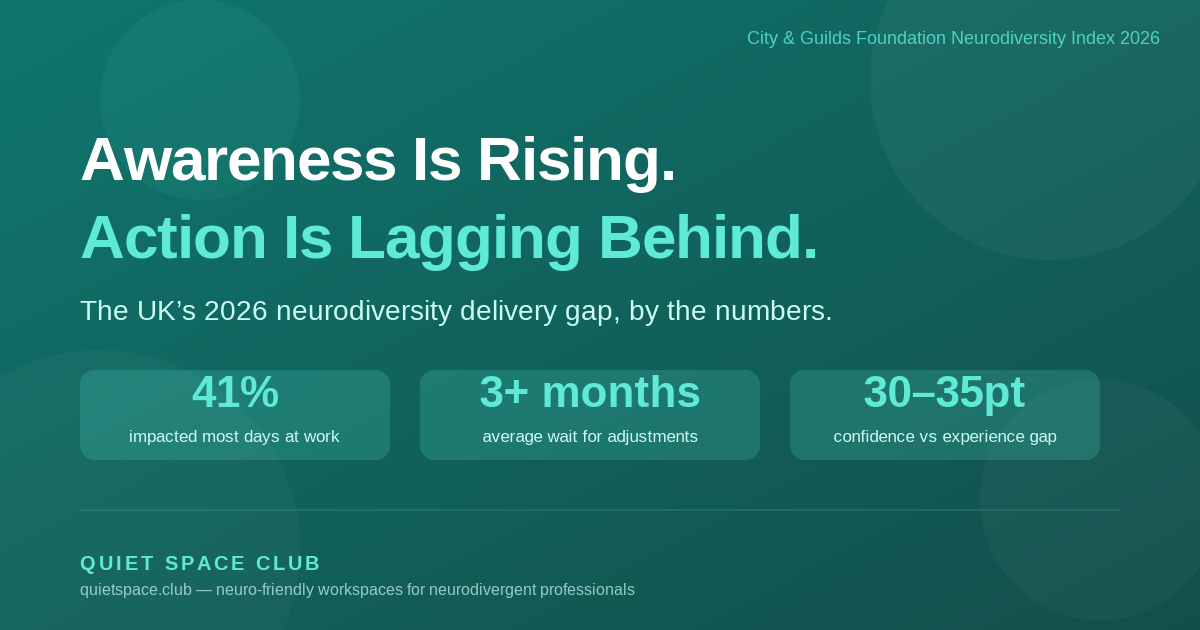
| Neurodivergent employees impacted by challenges most days | 41% | City & Guilds Neurodiversity Index 2026 |
| Employees waiting 3+ months for workplace adjustments | Twice the rate of other disabled employees | City & Guilds Neurodiversity Index 2026 |
| Gap between employer confidence and employee experience | 30–35 percentage points | City & Guilds Neurodiversity Index 2026 |
| Senior leaders who have received neurodiversity training | 35% (up from 28%) | City & Guilds Neurodiversity Index 2026 |
| Organisations involved in neurodiversity-related tribunals | 13% | City & Guilds Neurodiversity Index 2026 |
| UK employers with a neurodiversity policy | 36% | Editorialge / UK Workplace Surveys 2026 |
| Neurodivergent professionals experiencing burnout (vs neurotypical) | 2x more likely | NeuroBridge State of Neurodiversity 2026 |
| Employees who have received no neurodiversity training | 57% | UK Workplace Research 2026 |
What the Confidence Gap Actually Means
The 2026 Index documents something that many neurodivergent professionals will recognise immediately but that HR data has struggled to capture: the experience of working in an organisation that believes it is doing well, while you are drowning. Employer confidence in neuroinclusion sits between 70% and 80% across the surveyed organisations. Neurodivergent employee reports of actually feeling psychologically safe, or of trusting that adjustments will materialise, sit between 32% and 38%. That is a 30 to 35 percentage point gap between what employers believe they are delivering and what employees report receiving — and it has widened since the 2025 edition.
Professor Amanda Kirby MBBS MRCGP PhD FCGI, CEO of Do-IT Solutions and the lead researcher behind the Index, frames the challenge clearly: "This is not just an inclusion agenda. It is a productivity strategy, a health imperative, and a test of organisational maturity in a changing workforce." The report makes explicit that organisations cannot measure their way out of this problem by surveying only managers and HR teams — the data must come from neurodivergent employees themselves. Those of us building neuro-friendly workspaces at Quiet Space Club know this first-hand: our NeuroIndex assessment is grounded in the lived experience of neurodivergent people, not the assumptions of those designing the spaces.
The Adjustment Delay Problem: Still Broken After Four Years
One of the most damaging findings in the 2026 report is not new — but it is getting worse. Neurodivergent employees wait more than three months for workplace adjustments at twice the rate of other disabled employees. Adjustments — whether that means a quieter desk, a different lighting setup, written rather than verbal instructions, or flexible working arrangements — are the operational backbone of neuroinclusion. Without them, awareness campaigns and policy documents are irrelevant. An employee with ADHD who cannot get a noise-cancelling headset policy approved after three months of waiting is not experiencing neuroinclusion. They are experiencing neuroinclusion theatre.
The reasons for delay are structural. Many adjustment requests fall into no-man's-land between HR, line managers, occupational health, and facilities — with no single owner and no defined timeline. Even when goodwill exists, most organisations lack a clear process for handling neurodivergent-specific requests, which differ from standard disability accommodations in that they are often low-cost, preventative, and non-medical. The 2026 Index urges organisations to build dedicated adjustment pathways that are fast, transparent, and not contingent on formal diagnosis — a recommendation entirely consistent with how Quiet Space Club certifies workspace providers to ensure their environments genuinely accommodate neurodivergent needs from day one.
Pro Tip
If your organisation's adjustment process requires a formal medical diagnosis before anything is approved, it is likely excluding the majority of neurodivergent employees who are undiagnosed or self-identified. Consider a self-referral model: employees describe the challenge they face and the adjustment they need, without needing to name or prove a condition. This approach is faster, cheaper, and more legally defensible than a medicalised gating process.
Psychological Safety, Microaggressions, and Daily Impact
Beyond adjustments, the 2026 Index documents a deterioration in the day-to-day working environment for neurodivergent employees. 41% report being impacted by workplace challenges most days — a figure that should give any HR leader pause. These are not occasional rough days. They are the accumulated weight of environments, expectations, and interpersonal dynamics that were not designed with neurodivergent people in mind: open-plan offices without acoustic refuges, meetings that run without agendas, performance processes that reward extroversion, and social norms that pathologise difference.
Alongside this, the Index records an increase in reported microaggressions — comments, exclusions, and assumptions that individually may seem trivial but collectively erode the psychological safety of neurodivergent employees. Psychological safety — the sense that one can speak up, make mistakes, and ask for support without fear of being seen as less capable — sits at the core of inclusive workplaces. Without it, even technically capable employees cannot access their own potential. The NeuroBridge State of Neurodiversity 2026 report corroborates this, finding that neurodivergent professionals are twice as likely to experience high symptoms of burnout compared to their neurotypical colleagues. This is not a wellbeing issue sitting at the margins of HR strategy. It is a talent crisis in slow motion.
Training Progress — and What It Is Missing
The 2026 Index does document genuine progress in one area: senior leader training. 35% of senior leaders have now received neurodiversity training, up from 28% in 2025. This matters because neuroinclusion that reaches only frontline managers but not the C-suite tends to produce pockets of good practice rather than systemic change — and policies that exist on paper but do not survive the next restructure. The upward trend is encouraging. But 35% still means that almost two thirds of senior leaders in the surveyed organisations have received no training at all, and the broader workforce figure is grimmer still: 57% of all employees have received no neurodiversity training of any kind.
The gap between senior leader training and workforce-wide understanding matters because neuroinclusion is not primarily a leadership challenge — it is a daily interaction challenge. Line managers who have received no training, colleagues who do not understand why someone needs to leave a noisy room, or team members who interpret a processing difference as rudeness or incompetence: these are the micro-level dynamics that determine whether a neurodivergent employee can actually use the adjustments that HR has theoretically approved. Neuro-friendly workspaces address the physical environment — but an organisation also needs its people to understand what neuroinclusion looks like in practice, every day.
Pro Tip
Before rolling out another neurodiversity awareness module, audit whether your line managers have the tools and authority to actually implement adjustments. The Index data suggests that awareness at leadership level is not translating into changed day-to-day behaviour. A 30-minute conversation between a manager and their neurodivergent direct report — with a clear adjustment request form and a defined five-day response deadline — will achieve more than most eLearning courses.
Tribunal Risk and the Policy Gap
13% of organisations surveyed in the 2026 Index have already been involved in neurodiversity-related employment tribunals. Broader industry data puts the growth of neurodiversity-related tribunal claims in the UK at 164% over the last four years. This is not a niche legal risk — it is a mainstream employment liability, and it is growing precisely because the gap between what employers say they do and what neurodivergent employees experience continues to widen. Most tribunal cases do not arise because an employer refused to support a neurodivergent employee outright; they arise because the process was slow, inconsistent, undocumented, or invalidating — the precise patterns the 2026 Index identifies as endemic. Only 36% of UK employers currently have a neurodiversity policy in place, which means the majority of organisations have no framework for responding consistently when a neurodivergent employee raises a need.
For workspace providers, the picture is similarly uneven. Many providers who would benefit from Quiet Space Club certification are currently operating without a clear neuroinclusion standard — no acoustic assessment, no lighting audit, no sensory environment review. As demand for certified neuro-friendly spaces grows among neurodivergent professionals and the employers who support them, this gap becomes both a reputational and a commercial risk for providers who have not yet acted.
What Good Looks Like in 2026
The 2026 Index is not only a catalogue of failures — it also documents what organisations that are getting this right are doing differently. The common factors among higher-performing organisations include: a defined and fast adjustment process that does not require formal diagnosis; neurodiversity included explicitly in DEI strategy rather than bolted on as an afterthought; line manager training that goes beyond awareness to practical skill-building; regular listening exercises that gather data from neurodivergent employees directly; and physical environments — including third-party workspaces — that are assessed against meaningful neuroinclusion standards rather than generic accessibility checklists. The Quiet Space Club directory exists precisely to make that last element easier: a curated, certified list of UK spaces where neurodivergent professionals can work, meet, and focus without the sensory and social load of conventional offices.
What is the City & Guilds Foundation Neurodiversity Index 2026?
The Neurodiversity Index is an annual report produced by the City & Guilds Foundation in partnership with Do-IT Solutions. Now in its fourth year, the 2026 edition surveys neurodivergent employees and employers across the UK and Ireland to measure the state of neuroinclusion, track progress over time, and identify where gaps between policy and practice are widest.
What does the 'delivery gap' mean in the context of the 2026 report?
The delivery gap refers to the 30–35 percentage point difference between employer confidence in their neuroinclusion efforts (70–80%) and neurodivergent employees' actual experience of psychological safety and adjustment support (32–38%). In short: organisations believe they are doing well; their neurodivergent employees largely disagree.
Why are neurodivergent employees waiting so long for workplace adjustments?
The 2026 Index attributes the delay to structural fragmentation — adjustment requests typically pass between HR, line managers, occupational health, and facilities without a clear owner or deadline. Many organisations also require formal diagnosis before acting, which excludes the large proportion of neurodivergent employees who are self-identified or in the diagnostic queue. Best practice involves a self-referral adjustment pathway with a defined response timeline.
What is the legal risk for UK employers who do not address neurodiversity?
Neurodiversity-related employment tribunal claims have grown by 164% in the UK over the last four years. The 2026 Index found that 13% of surveyed organisations had already been involved in such cases. Most claims arise not from outright refusal but from slow, inconsistent, or invalidating processes — which is precisely what the Index documents as the current norm. Having no neurodiversity policy (the situation for 64% of UK employers) significantly increases this risk.
How can neuro-friendly workspaces help address the findings of the 2026 Index?
Certified neuro-friendly workspaces remove the physical and sensory barriers that compound the daily challenges documented in the Index. For neurodivergent professionals who cannot get their office environment adjusted quickly enough, access to a <a href="/spaces/">quiet, certified workspace</a> can be the difference between a sustainable working week and burnout. For employers, providing access to such spaces is one of the fastest adjustments they can make — no procurement process required, no facilities sign-off needed.