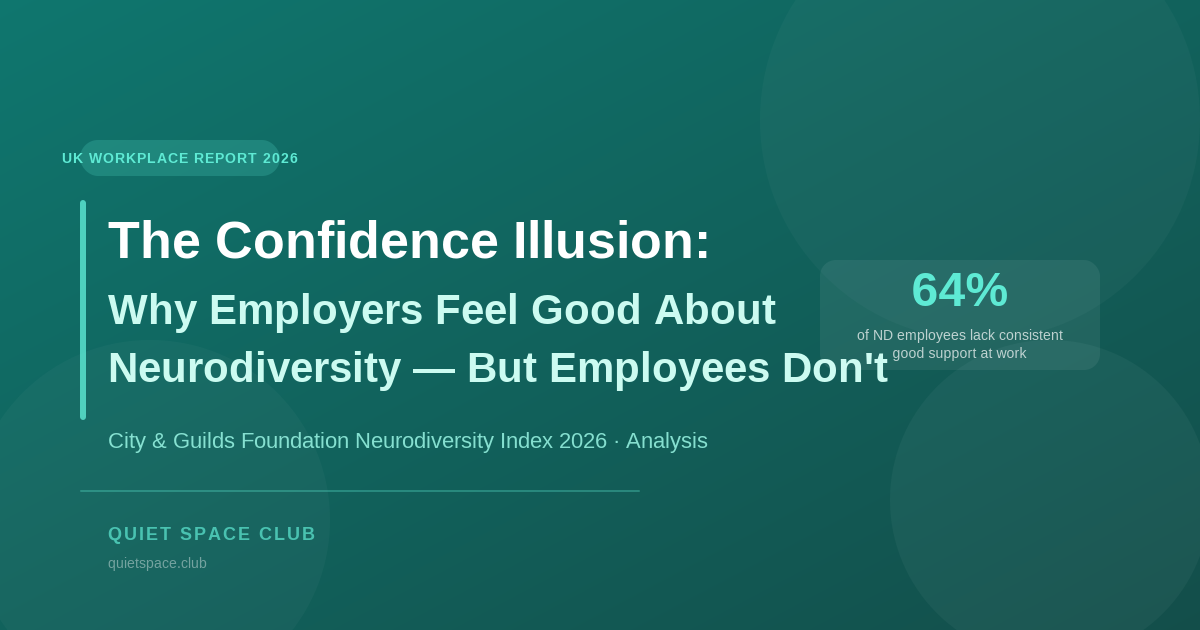
For the fourth consecutive year, the City & Guilds Foundation Neurodiversity Index has taken the temperature of neurodiversity across UK and Irish workplaces. The 2026 edition, produced in partnership with Do-IT Solutions under the leadership of Professor Amanda Kirby, lands with a finding that should concern every HR leader, DEI professional, and neurodivergent employee in the country: employer confidence is rising, but the gap between what organisations believe they're doing and what neurodivergent employees are actually experiencing has never been wider. Awareness without infrastructure is not inclusion — it's theatre.
Key Findings at a Glance
| Metric | Data Point | What It Means |
|---|---|---|
| ND employees lacking consistent support | 64% | Nearly two-thirds do not receive reliable help when they ask for it |
| Employers with a neurodiversity policy | 36% | Most organisations have no documented framework at all |
| Neurodiversity in DEI strategy | Fewer than 4 in 10 | Neuroinclusion remains an afterthought in most DEI agendas |
| ND employees experiencing burnout risk | 2× more likely | Compared to neurotypical colleagues (McKinsey data) |
| Hiring managers trained on ND | 46% | Over half have had no preparation for neurodivergent candidates |
| Managers lacking ND confidence | 56% | More than half admit they don't know how to support ND colleagues |
| Managers without any ND training | 70%+ | The majority have never received neurodiversity-specific guidance |
What the Confidence Gap Actually Looks Like
The 2026 Index documents a striking paradox. Organisations are more likely than ever to say they take neurodiversity seriously. Senior leaders speak about it, internal networks are growing, and awareness campaigns are becoming routine. Yet neurodivergent employees report longer waits for workplace adjustments, lower psychological safety, and greater exposure to microaggressions than in previous years. The confidence, it turns out, belongs largely to the employer — not the employee.
This is not a minor discrepancy. When the gap between stated commitment and lived experience widens, it actively damages trust. Neurodivergent employees who see their employer celebrate Neurodiversity Celebration Week while their adjustment request sits unanswered for three months do not feel included — they feel gaslit. The Index flags that this dynamic is accelerating, and that without structural change, awareness campaigns risk becoming counterproductive.
The Policy Problem: Most Employers Are Flying Blind
Only 36% of UK employers currently have a neurodiversity policy, and fewer than four in ten reference neurodiversity in their DEI strategy at all. This means that in the vast majority of organisations, neuroinclusion depends entirely on individual champions — a sympathetic HR business partner, a manager who happens to understand, a colleague willing to advocate. When those people leave, the support disappears with them. That is not inclusion. It is luck.
The absence of policy creates two further problems. First, it makes it nearly impossible to apply adjustments consistently across teams and business units, so two neurodivergent employees in the same organisation may have radically different experiences depending on which manager they report to. Second, it leaves organisations dangerously exposed to legal challenge. Neurodiversity-related employment tribunals have risen 164% in four years, and in many cases the employer's liability stems not from malice but from the absence of any framework that managers could actually follow.
Pro Tip
If your organisation doesn't have a neurodiversity policy, start by auditing your existing reasonable adjustments process. Ask: does a neurodivergent employee need to formally disclose a condition before accessing support? If the answer is yes, you're already losing people before the conversation begins. Redesign access to adjustments so it begins with a conversation about how someone works best — not what their diagnosis is.
Wellbeing Is Deteriorating, Not Improving
One of the most sobering findings in the 2026 landscape is that despite higher corporate awareness, wellbeing outcomes for neurodivergent employees are moving in the wrong direction. Research cited by NeuroBridge's 2026 workplace analysis shows that neurodivergent professionals are twice as likely to experience high symptoms of burnout, and more than half have taken absence specifically due to workplace challenges. These are not personal failures. They are the predictable outcome of environments that were not designed with different cognitive needs in mind.
The mechanism is well understood: when a workplace's default communication styles, sensory environment, and performance expectations do not account for neurodivergent needs, employees spend enormous energy masking and compensating simply to meet baseline expectations. This is exhausting in a way that compounds over time — and it's invisible to managers who equate presence with performance. Organisations that are not actively providing neuro-friendly workspaces and conditions are, in effect, asking neurodivergent employees to pay a daily cognitive tax that their neurotypical colleagues do not.
The Manager Problem Everyone Knows About But Nobody Solves
The data on managers is particularly striking — and particularly consistent year on year. Over 60% of neurodivergent employees say their line manager is their first port of call for support. Around 70% of overall team engagement is directly linked to manager behaviour. And yet: 56% of managers admit they lack the confidence or knowledge to support neurodivergent colleagues effectively, and more than 70% have never received any neurodiversity-specific training. This is not a training budget problem. It is a prioritisation problem.
When managers are the primary delivery mechanism for neuroinclusion but have no preparation, the result is exactly what the Index documents: inconsistency, avoidable mistakes, and a reliance on the neurodivergent employee themselves to educate their manager about their own needs — often at significant personal and professional cost. Understanding what a genuinely neuroinclusive environment requires starts with equipping the people closest to neurodivergent employees to respond well. That means more than a one-hour awareness session at Neurodiversity Celebration Week.
Pro Tip
Practical manager training on neurodiversity should cover three things: how to have an adjustment conversation without requiring a formal diagnosis; how to flex communication styles for different cognitive profiles; and how to recognise masking and early burnout signals. These are skills — not just attitudes — and they require practice, not just information. Consider role-play scenarios and peer coaching rather than passive e-learning modules.
Talent Being Filtered Out Before It Is Even Seen
The Index also surfaces a significant failure point that sits upstream of employment altogether: recruitment. Only 46% of hiring managers have received any training on supporting neurodivergent candidates. Many job descriptions still prioritise narrow communication styles — confident eye contact, polished small talk, fast-paced group interviews — over the actual capabilities the role requires. Almost half of neurodivergent candidates say they avoid disclosing during the application process due to fear of stigma, even though neurodivergent professionals report high proficiency in many of the fastest-growing skills needed in the economy by 2030.
This is not just an inclusion failure. It is a talent strategy failure. Organisations are structurally filtering out capable people because their hiring architecture was designed for a narrow cognitive profile. Workspace providers who want to attract neurodivergent professionals — and the organisations that employ them — need to rethink not just where work happens, but how the entire hiring process signals whether different minds are genuinely welcome.
What Genuine Neuroinclusion Looks Like in 2026
The organisations that are closing the confidence gap share a set of characteristics. They have moved neuroinclusion from an awareness agenda to an operational one — embedding it in recruitment processes, adjustment frameworks, manager development, and workspace design. They do not wait for disclosure to begin supporting an employee. They build environments where disclosure is lower stakes, because the default environment already works better for a wider range of cognitive profiles. And they measure outcomes at team level — not just policy adoption — so they can see whether their investment is actually reaching the people it was built for.
The Quiet Space Club platform exists precisely to support this shift. A neuro-friendly workspace is not a special accommodation bolted onto a standard office — it is a design choice that makes work more sustainable and more productive for everyone. Sensory considerations, flexible work patterns, clear communication norms, and low-stimulation retreat spaces benefit neurotypical and neurodivergent employees alike. The organisations that understand this are not just doing the right thing. They are building workplaces that retain talent and perform better.
What is the City & Guilds Foundation Neurodiversity Index?
The City & Guilds Foundation Neurodiversity Index is an annual UK benchmark study produced in partnership with Do-IT Solutions. Now in its fourth year, it tracks the state of neurodiversity support across UK and Irish workplaces, measuring both employer-reported practices and neurodivergent employees' lived experience. The 2026 report found a widening gap between employer confidence and employee outcomes.
Why is the gap between employer confidence and employee experience growing?
The gap is widening because many organisations have invested in awareness — campaigns, networks, leadership statements — without investing in infrastructure. Without a neurodiversity policy, trained managers, or redesigned adjustment processes, neuroinclusion remains dependent on individuals rather than embedded in how the organisation operates. Awareness raises expectations; when those expectations meet unchanged systems, the disconnect grows.
What is the single most impactful thing an employer can do to close the gap?
Equip line managers. Since over 60% of neurodivergent employees turn to their manager first for support, and since manager behaviour drives around 70% of team engagement, manager capability is the highest-leverage intervention available. That means structured neurodiversity training, not just a one-off awareness session — covering adjustment conversations, communication flexibility, and burnout recognition.
Does a neurodivergent employee need a formal diagnosis to receive workplace adjustments?
No — and requiring one is both legally risky and practically harmful. Under the Equality Act 2010, reasonable adjustments may be required for conditions that have a substantial and long-term adverse effect on day-to-day activities, regardless of whether a formal diagnosis exists. More importantly, many neurodivergent people are undiagnosed. Designing adjustment processes that begin with "how do you work best?" rather than "what is your diagnosis?" reaches far more of the people who need support.
How can neuro-friendly workspaces help address the confidence gap?
Physical and environmental design is one of the most tangible ways to demonstrate that different cognitive needs are genuinely considered. Quiet zones, adjustable lighting, low-stimulation areas, and clear wayfinding reduce the daily masking load for neurodivergent employees before they ever need to make a formal adjustment request. <a href="/spaces/">Certified neuro-friendly spaces</a> signal inclusion structurally, not just rhetorically — which is exactly what the 2026 Index shows employees are looking for.