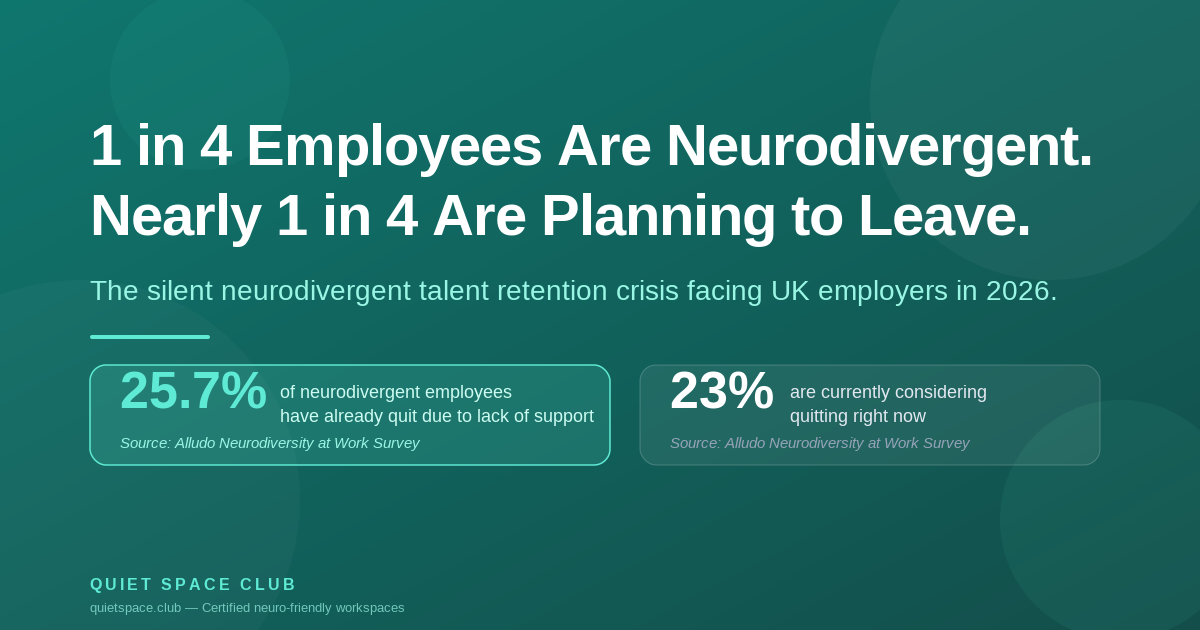
Two findings published in 2026 should be read together by every HR leader in the UK. The first, from Dublin City University's Institute of Education: one in four corporate employees now self-identify or have been formally diagnosed as neurodivergent — a share far higher than most organisations have ever planned for. The second, from Alludo's Neurodiversity at Work Survey: 25.7% of neurodivergent employees have already quit a job because their employer failed to support their needs, and 23% are currently considering doing so. Put those numbers side by side and you are looking at a quiet, accelerating talent exodus that most British employers have not yet begun to measure — let alone address.
Key Data at a Glance
| Metric | Finding | Source |
|---|---|---|
| Employees who self-identify as neurodivergent | 1 in 4 (25%) | Dublin City University, 2026 |
| Neurodivergent employees who have quit due to lack of support | 25.7% | Alludo Neurodiversity at Work Survey |
| Currently considering quitting for the same reason | 23% | Alludo Neurodiversity at Work Survey |
| Primary reason for non-disclosure: fear of being seen as incompetent | 70.1% | Alludo Neurodiversity at Work Survey |
| Employees who think their employer ineffectively trains managers | 35% | Acas/YouGov, February 2026 |
| Employers who effectively train managers on neurodiversity | 32% | Acas/YouGov, February 2026 |
| Neurodivergent employees likely experiencing significant depression | 18.5% | DCU Institute of Education, 2026 |
| Younger neurodivergent workers (<35) most likely to quit | Highest risk group | Alludo Neurodiversity at Work Survey |
The Scale of Neurodivergence Most Employers Have Not Accepted
The DCU finding alone warrants a rethink of how most organisations approach neuroinclusion. A study of over 1,500 corporate employees found that 25% self-identify or have a formal diagnosis of a neurodivergent condition — conditions including ADHD, autism, dyslexia, dyspraxia and dyscalculia. Acas estimates the UK figure at between 15% and 20% of the adult population, and rising as diagnosis rates climb and cultural awareness grows. What both figures signal is the same: neurodivergence is not a niche concern. It is a mainstream workforce reality, and the policies, processes and physical environments most organisations have built are not designed for the people who are already in them.
Critically, the DCU research found that the wellbeing of neurodivergent employees is significantly worse than that of their neurotypical colleagues. 18.5% of neurodivergent employees are likely experiencing significant levels of depression based on the WHO-5 Well-Being Index. These individuals are not on sick leave or recorded in any adverse way — they are simply deteriorating quietly inside organisations that have not asked the right questions. The business cost of that deterioration shows up later, in attrition data, in sickness absence, and increasingly in employment tribunals. The NeuroIndex assessment used by Quiet Space Club to evaluate workspaces is built precisely to identify whether environments are supporting or compounding this kind of invisible load.
The Retention Numbers Employers Are Not Tracking
The Alludo survey data on attrition is among the most commercially significant neurodiversity data published in 2026. When nearly a quarter of neurodivergent employees have already left a role due to inadequate support, and another 23% are actively weighing whether to do the same, the aggregate impact on UK workforce planning is enormous. This is not a future risk — it is a current one, and it disproportionately affects the youngest and most sought-after talent. Employees under 35 are the most likely to quit when they do not feel supported, and younger workers are both more likely to have a neurodivergent diagnosis and more likely to be open about it. The demographic most organisations are competing hardest to attract is also the group most likely to leave if neuroinclusion falls short.
Standard exit interview processes rarely capture this. Neurodivergent employees leaving due to a mismatch with their working environment or a failure of managerial support are unlikely to name it explicitly in a structured exit conversation — particularly if, as Alludo's data shows, 70.1% of those who have not disclosed their neurodivergence at work did so because they feared being seen as incapable. If they did not disclose on the way in, they are unlikely to disclose on the way out. The attrition registers as "personal reasons" or "a better opportunity", and the real driver goes unmeasured. Quiet Space Club exists partly for this reason: to create a pathway to neuro-friendly working environments that does not depend on disclosure as a precondition.
Pro Tip
If your organisation does not currently ask neurodiversity-specific questions in exit surveys (anonymously and optionally), you almost certainly have a gap in your retention data. Consider adding a voluntary, anonymous question such as: "Did the physical or sensory environment of your role contribute to your decision to leave?" You will be surprised by what surfaces — and it will be more honest than a face-to-face exit interview.
Why Managers Are the Critical Failure Point
For most neurodivergent employees, the relationship with their line manager is the single biggest determinant of whether they stay or leave. That makes the Acas/YouGov survey data from February 2026 particularly alarming. Of 1,000 employees surveyed across Great Britain, only 32% think their organisation effectively trains managers to make reasonable adjustments for neurodivergent colleagues. A further 35% say their employer is actively ineffective at this — with 18% describing it as "very ineffective". Perhaps most troubling of all: 32% said they simply did not know how effective their employer was at supporting neurodivergent staff. That level of opacity means the problem is invisible to the people who experience it, which makes escalation, measurement and change all but impossible.
The Acas finding is consistent with patterns seen across multiple 2026 reports: awareness has risen, but operational competence has not followed. Managers who have attended a lunch-and-learn on ADHD are not equipped to have a meaningful adjustment conversation, identify sensory overload, or create the psychological safety that neurodivergent employees need in order to disclose and seek support. Workspace providers who seek certification through the Quiet Space platform are assessed not just on physical environment but on whether their teams understand and can respond to neurodivergent needs. Policy on paper rarely survives contact with a manager who has never been properly trained.
What Neurodivergent Employees Actually Need to Stay
The Alludo survey asked neurodivergent employees directly what strategies they had found most effective in making work sustainable. The answers are instructive because they are not primarily about diagnosis-specific accommodations — they are about flexibility, autonomy and restoration. Working from home was cited by 51.2% of respondents as an effective strategy. Taking regular breaks (47.6%), mental health and wellness days (41.7%) and flexible scheduling (37.4%) followed. When asked what accommodations they would most value, the answers aligned: flexible schedule (73.1%), remote work option (60.8%) and paid time off or mental health days (48.8%). What this data describes is not a set of special adjustments — it is a working environment built around output rather than presence, trust rather than surveillance, and recovery rather than relentless availability.
The physical environment is a separate and consistently underappreciated variable. Certified neuro-friendly spaces in the Quiet Space directory are assessed against criteria that reflect what neurodivergent employees actually report needing: predictable sensory conditions, control over lighting and acoustics, access to quiet zones for focused work, and the ability to transition between different types of working environment without negotiating it with a manager each time. Many neurodivergent professionals find that accessing a certified workspace — even for two or three days a week — reduces the sensory and cognitive load of their working week significantly enough to make the difference between sustainable employment and deterioration.
Pro Tip
If your organisation is returning people to the office and has not specifically audited the sensory environment for neurodivergent suitability, you are almost certainly losing people you cannot see losing. The combination of open-plan noise, fluorescent lighting, unpredictable interruptions and back-to-back meetings creates a sensory load that accumulates invisibly over weeks and months. Providing access to <a href="/spaces/">certified neuro-friendly workspaces</a> as part of your hybrid policy is one of the most evidence-backed retention interventions available — and one of the least commonly used.
What to Do If You Are Losing Neurodivergent Talent
The first step is to accept that you probably are, and that your current data systems are not designed to show you this. Standard attrition metrics, pulse surveys and performance management frameworks are built around neurotypical norms and will not surface the specific experience of neurodivergent employees unless you design for it. That means anonymous neurodiversity-specific feedback mechanisms, manager training that goes beyond awareness to equip people to have adjustment conversations, and a genuine audit of the physical and sensory working environments you are asking people to function in every day. Organisations that have done this work — built infrastructure rather than just awareness — consistently report not just improved retention but measurably higher productivity, engagement and innovation from their neurodivergent workforce.
The competitive pressure to act is sharpening. As the DCU finding makes clear, one in four of the people currently working in British organisations are neurodivergent. As awareness grows, diagnosis rates climb and younger workers become increasingly unwilling to mask indefinitely, that proportion will become more visible, more vocal and more mobile. The organisations that will retain this talent are those that have already built the systems, environments and cultures in which neurodivergent people can genuinely thrive — not those that are still treating neuroinclusion as an edge case to be handled by HR.
How many employees in the UK are neurodivergent?
Research from Dublin City University's Institute of Education, published in 2026 and based on a survey of over 1,500 corporate employees, found that 1 in 4 (25%) self-identify or have been formally diagnosed as neurodivergent. Acas estimates the figure at 15–20% of the adult population in the UK. Both figures are almost certainly underestimates given the significant proportion of neurodivergent adults who remain undiagnosed.
Why do neurodivergent employees leave their jobs?
Alludo's Neurodiversity at Work Survey found that 25.7% of neurodivergent employees have already quit a job because their employer did not sufficiently support their needs. The main drivers include inadequate workplace adjustments, working environments that cause sensory overload, lack of flexible working, managers who lack training in neurodiversity, and a culture where disclosure feels too risky. Younger employees under 35 are most likely to act on this and leave.
What do neurodivergent employees need most to stay in a job?
Alludo's survey found the most effective strategies for neurodivergent employees were: remote work (cited by 51.2%), regular breaks (47.6%), mental health or wellness days (41.7%) and flexible scheduling (37.4%). When asked what accommodations they would value most, flexible schedules (73.1%), remote work options (60.8%) and paid time off or wellness days (48.8%) topped the list. Physical environment is also critical — access to low-stimulation, quiet spaces significantly reduces sensory load and burnout risk.
Why are neurodivergent employees not disclosing their needs at work?
70.1% of neurodivergent employees who have not disclosed say their primary reason is fear of being seen as incapable of doing their job. A further 54% are concerned about being treated differently, and 38.5% worry about being overlooked for promotions or new opportunities. The system is designed around disclosure as a precondition for support — but the majority of neurodivergent employees have already assessed that making themselves visible in this way carries more risk than it's worth.
What is the business cost of failing to retain neurodivergent employees?
Beyond the direct cost of recruitment — typically estimated at 30–50% of annual salary per lost employee — organisations failing neurodivergent staff also lose disproportionate innovation capacity. Research suggests neurodivergent teams can be up to 30% more productive in certain roles when properly supported. The legal cost is also rising: neurodiversity-related employment tribunal cases in the UK increased by 164% over the last four years. The cost of acting early is substantially lower than the cost of continued inaction.