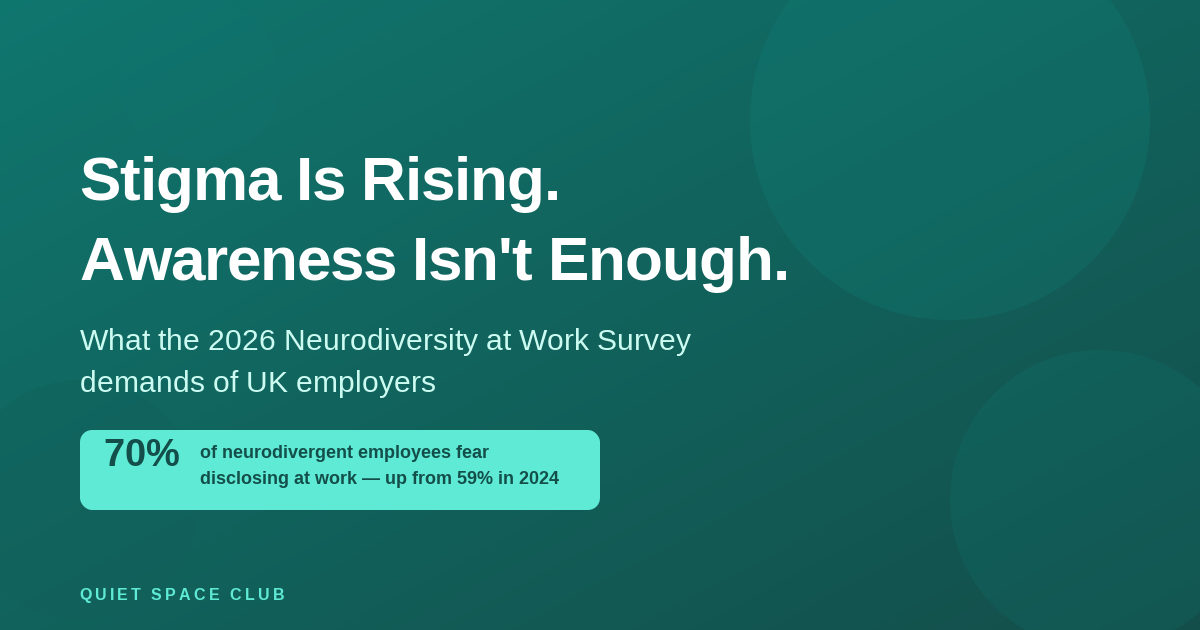
Awareness of neurodiversity in the workplace has never been higher. Most managers say they understand what neurodiversity means. Most organisations say their workplaces are accessible. And yet, according to the third annual Neurodiversity at Work survey by Understood.org, released in May 2026, the proportion of neurodivergent employees who fear that disclosing their condition will harm their career has risen — from 59% in 2024 to 70% today. That is not a rounding error. That is a 11-percentage-point surge in fear, in a two-year period when neurodiversity has supposedly been climbing the corporate agenda. For UK HR professionals, this data should be genuinely alarming — and it demands a hard look at the difference between awareness and action.
Key Findings at a Glance
| Metric | Finding | Change vs. 2024 |
|---|---|---|
| Neurodivergent employees who fear disclosure will harm them | 70% | Up from 59% |
| Neurodivergent employees who don't know their accommodation entitlements | 70% | Up from 60% |
| Neurodivergent employees who don't know who to ask about adjustments | 60% | Up from 49% |
| Adults saying employers need better accommodation education | 85% | New measure |
| Neurodivergent employees using AI tools at work | 78% | vs. 59% of neurotypical peers |
| Neurodivergent employees more likely to apply for roles thanks to AI | 56% | vs. 45% of neurotypical |
| Neurodivergent women who feel pressure to "mask" at work | 75% | vs. 69% of neurodivergent men |
| Neurodivergent women denied accommodations after requesting them | 22% | vs. 7% of neurotypical women |
The Stigma Paradox: Awareness Without Action
The survey, conducted by The Harris Poll among more than 2,000 US adults in March 2026 — of whom 614 identify as neurodivergent — paints a paradoxical picture. Seventy-three percent of employed adults say their workplace is accessible for neurodivergent employees. Sixty-nine percent believe their manager understands neurodiversity. These numbers suggest real progress. But when you ask the people those workplaces are supposedly designed to include, a very different story emerges.
Seven in ten neurodivergent employees have no idea what accommodations they are actually entitled to — a figure that has risen by ten points in just two years. Six in ten do not know who to speak to in their organisation about requesting adjustments, up from 49% in 2024. And 85% of all adults surveyed — neurotypical and neurodivergent alike — say employers need to do more to educate their workforce about what accommodations are available. The gap between what organisations believe they offer and what employees actually experience is not closing. It is widening. This is precisely the pattern identified in the City & Guilds Neurodiversity Index 2026, which found a 30–35 percentage-point gap between employer neuroinclusion confidence and employee lived experience across UK organisations.
What This Means for UK Employers
While the Understood.org survey was conducted in the United States, the dynamics it captures are acutely recognisable in a UK context. UK employment law already requires employers to make reasonable adjustments for disabled employees — and neurodivergent conditions including ADHD, autism, dyslexia, and dyspraxia can qualify as disabilities under the Equality Act 2010. Yet the fact that 60% of neurodivergent employees globally do not know who to approach about adjustments suggests a systemic failure in how organisations communicate their own policies. For UK employers, the risk is not only reputational. Neurodiversity-related employment tribunal claims have risen sharply in recent years, and the cost of defending or losing such cases is substantial. But the more important argument is not legal — it is human and commercial. If neurodivergent employees cannot safely access the adjustments they are entitled to, organisations are losing the full contribution of a significant proportion of their workforce. The NeuroIndex framework used to assess spaces listed on Quiet Space Club consistently finds that physical environment is one of the most controllable factors in neurodivergent performance — but it only matters if employees feel safe enough to ask for it in the first place.
Pro Tip
Audit your adjustments process right now — not your policy document, but the actual employee experience. Ask: does every manager know what adjustments are available? Does every neurodivergent employee know who to contact? Is there a clear, low-stigma route to making a request without going through a formal HR process? If the answer to any of these is "probably not", that is your starting point. Publish a plain-English guide to available accommodations on your intranet and circulate it to all staff, not just new joiners.
AI Is Changing the Disclosure Calculation — for Better and Worse
One of the most striking findings in the Understood.org survey is the role of artificial intelligence in reshaping the neurodivergent experience at work. Seventy-eight percent of neurodivergent employees already use AI tools professionally, compared with 59% of their neurotypical peers — suggesting neurodivergent workers have embraced AI as a coping and productivity tool at a notably higher rate. More significantly, 57% say they would be more likely to disclose their neurodivergence if their employer provided specialised AI tools as a standard accommodation: co-pilots, AI assistants, and tools that help with task management, communication, and organisation. And 56% say the availability of such tools has made them more confident applying for high-level roles they previously avoided. This is genuinely encouraging data. AI is functioning as a practical leveller — reducing the friction of tasks that present disproportionate challenges for neurodivergent professionals, from summarising long meetings to breaking multi-step projects into manageable chunks. But there is a shadow side. If AI tools are helping some neurodivergent employees perform more effectively without formal disclosure, organisations may be deceived into believing inclusion is improving, when what they are actually seeing is more sophisticated masking. The underlying stigma problem — the reason disclosure feels unsafe in the first place — remains unaddressed.
Neurodivergent Women Face Compounded Barriers
The survey data on neurodivergent women deserves particular attention. Three in four (75%) report feeling pressure to mask or conform to neurotypical behaviours at work due to stigma, compared with 69% of neurodivergent men. They are significantly more likely than neurotypical women to fear leaving their current role because they worry a new employer will not support them — 68% versus 37%. And 22% of neurodivergent women who requested formal accommodations report being denied, compared with just 7% of neurotypical women. This disparity is not a coincidence. Neurodivergent conditions in women are frequently diagnosed later in life, if at all, because diagnostic criteria were historically developed primarily on male populations. Many neurodivergent women enter the workforce without a formal diagnosis, which means they may lack the documentation employers request before granting adjustments — yet they carry the full cognitive and emotional load of navigating a workplace not designed for them. For UK employers committed to gender equity, this data is a reminder that neurodivergent inclusion is also a women's inclusion issue, and that policies which appear neutral in practice may create compounded disadvantage.
Pro Tip
Do not require a formal diagnosis before offering support. UK best practice — and increasingly legal expectation — is to assess the functional impact of a condition on an employee's work, not to gatekeep adjustments behind medical paperwork. Many neurodivergent employees, particularly women, are awaiting assessments or have never been formally diagnosed. A "diagnosis-first" policy does not protect you legally — it exposes you to claims of indirect discrimination. A simple self-referral route to an occupational health assessment, with interim adjustments offered in the meantime, is a far more defensible and humane approach.
Turning Awareness Into Action: What Actually Moves the Needle
The Understood.org survey is a useful corrective to the temptation of performative neuroinclusion. Posting about Neurodiversity Celebration Week, or naming a neurodiversity champion, does not change the daily experience of an employee who is masking for eight hours, does not know what adjustments they are entitled to, and fears that asking will mark them out for passed-over promotions. What actually moves the needle is structural: clear, accessible adjustment processes; managers trained not just in awareness but in how to have a practical conversation about support; physical and hybrid environments that reduce sensory and cognitive load by default rather than by exception. The Quiet Space Club directory exists precisely because the physical environment is one of the highest-leverage, lowest-stigma interventions available. An employee who can work from a certified neuro-friendly workspace does not need to disclose, negotiate, or justify — they simply have access to an environment that works for their brain. For workspace providers looking to differentiate in an increasingly competitive market, formal neuroinclusion certification is a meaningful and commercially relevant signal. And for the organisations recommending or subsidising those spaces, it is one of the most tangible demonstrations that inclusion policy translates into practice.
Frequently Asked Questions
Why is disclosure fear rising even as neurodiversity awareness grows?
Awareness and psychological safety are not the same thing. Many organisations have improved their public language around neurodiversity without changing the underlying culture, management behaviours, or power dynamics that make disclosure risky. When employees see that disclosure can lead to being managed differently, overlooked for promotion, or labelled as "difficult", awareness of the topic does not counteract those concrete incentives to stay silent. The Understood.org data suggests the gap between stated values and lived experience is actually widening, which is consistent with findings from the City & Guilds Neurodiversity Index 2026.
Are UK employers legally required to offer neurodiversity accommodations?
Yes — where a neurodivergent condition meets the definition of a disability under the Equality Act 2010 (a physical or mental impairment with a substantial, long-term adverse effect on day-to-day activities), employers are required to make reasonable adjustments. ADHD, autism, dyslexia, dyspraxia, and related conditions frequently meet this threshold. Employers cannot wait for employees to request adjustments if they knew or reasonably should have known about the impairment. The Acas guidance on neurodiversity at work provides a useful practical framework for UK employers.
What AI tools are most useful for neurodivergent employees?
The most widely cited categories include: meeting summarisation tools (reducing the cognitive load of following and retaining spoken information); AI writing assistants (supporting dyslexic employees or those with executive function differences); task management and prioritisation tools (particularly beneficial for employees with ADHD); and real-time transcription or closed captioning (for those with auditory processing difficulties). The key is offering these as standard workplace tools for all employees rather than as a disclosure-triggered accommodation — which reduces stigma and increases uptake.
Why are neurodivergent women particularly disadvantaged?
Neurodivergent conditions in women are frequently underdiagnosed or diagnosed later in life, because diagnostic criteria were historically developed using predominantly male study populations. Women are also socialised to mask more effectively, meaning their difficulties are less visible — which reduces the likelihood of early intervention, diagnosis, and support. In the workplace, this often means neurodivergent women are less likely to have formal documentation, more likely to have spent years compensating without support, and more likely to face scepticism when they do request adjustments.
How can a neurodivergent professional find a neuro-friendly workspace in the UK?
The <a href="/spaces/">Quiet Space Club directory</a> lists certified neuro-friendly workspaces across the UK, assessed using the NeuroIndex methodology. Spaces are evaluated on sensory environment, acoustics, lighting, flexibility, and neuroinclusion culture — so you can find a venue that genuinely works for your brain, without having to disclose or negotiate with an individual workspace provider. The <a href="/how-it-works/">assessment process</a> is explained in detail on the site.