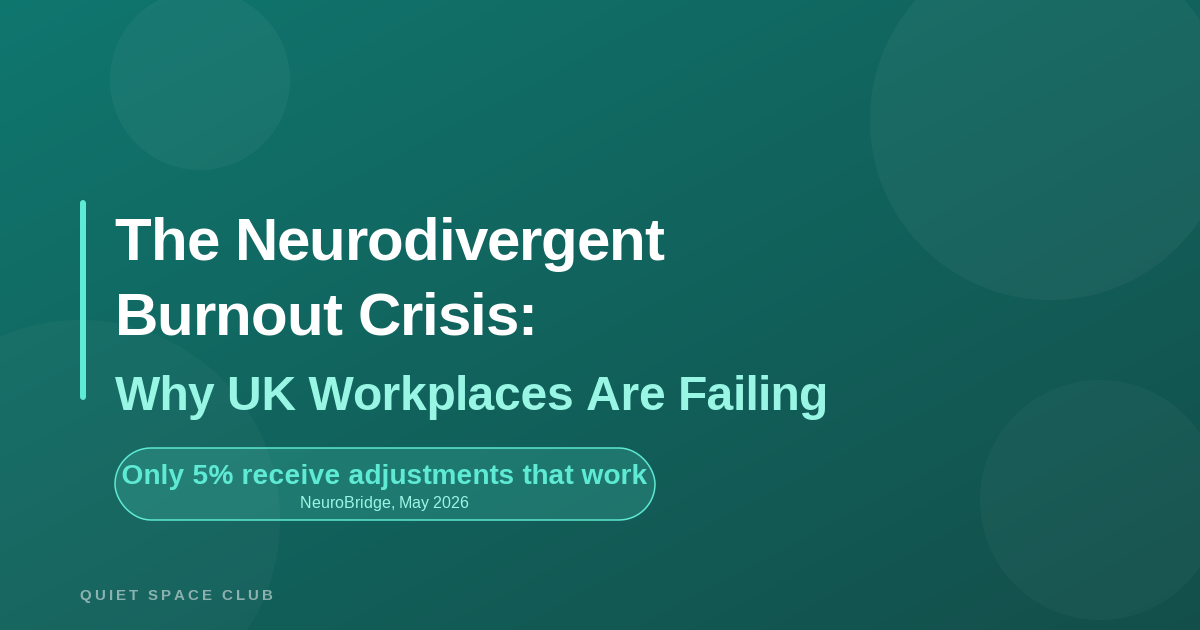
A new figure published this week should stop every HR director in their tracks. According to NeuroBridge's May 2026 analysis of UK client audit data, only 5% of neurodivergent employees receive workplace adjustments that actually work. A further 82% receive no adjustments at all. The remaining 13% have adjustments in place that don't meet their real needs. This isn't a compliance failure hiding in the margins — it is the mainstream reality of being neurodivergent at work in Britain right now, and it is driving a burnout crisis that employers can no longer afford to ignore.
Key Data at a Glance
| Metric | Finding | Source |
|---|---|---|
| Neurodivergent employees receiving no adjustments | 82% | NeuroBridge audit data, May 2026 |
| Neurodivergent employees with adjustments that work | 5% | NeuroBridge audit data, May 2026 |
| Those who haven't disclosed citing fear of career impact | 73% | NeuroBridge White Paper, 2025 |
| Neurodivergent workers twice as likely to experience burnout | 2x | McKinsey MHI / NeuroBridge, 2026 |
| Employees who have taken time off due to neurodivergence | 51% | City & Guilds Neurodiversity Index 2025 |
| UK employers with a neurodiversity policy | 36% | City & Guilds Neurodiversity Index 2026 |
| Neurodivergent employees likely experiencing depression | 18.5% | DCU Institute of Education, 2026 |
| Neurodiversity employment tribunal cases rise (4 years) | +164% | NeuroBridge State of ND Report, 2026 |
Why Neurodivergent Burnout Is Accelerating in 2026
Neurodivergent burnout is distinct from ordinary workplace stress. It is the result of sustained masking — the exhausting practice of suppressing natural cognitive patterns to meet neurotypical workplace expectations — combined with environments that are rarely designed to accommodate different sensory, communication or processing needs. Research cited by NeuroBridge shows that neurodivergent professionals are twice as likely to experience high burnout symptoms as their neurotypical peers. Yet the very systems meant to prevent this outcome are barely functioning. When 82% of people receive no adjustments, burnout is not a risk to be managed — it is a predictable outcome of current working conditions.
The DCU Institute of Education's landmark 2026 survey of over 1,500 corporate employees found that 18.5% of neurodivergent workers are likely experiencing significant levels of depression, based on the WHO-5 Well-Being Index. These are not people in crisis who have sought help — they are people quietly deteriorating inside organisations that believe they are doing enough. And behind every absence, grievance or exit interview lies a system that failed to act early enough. According to City & Guilds' Neurodiversity Index, 51% of neurodivergent employees have taken time off work specifically because of their neurodivergence — with burnout, workplace conflict and unaddressed mental health cited as the primary reasons.
The Disclosure Trap: Why the System Is Built on a Precondition Most People Can't Meet
The standard UK workplace adjustment pathway requires an employee to disclose — to a manager, to HR, often in writing — before support becomes available. In theory this is straightforward. In practice, it demands that neurodivergent individuals make themselves visible inside a system they have often already assessed as unsafe. NeuroBridge's audit data reveals the calculation most people are making: 73% of those who haven't disclosed say it is because they fear career impact. They expect their disclosure to follow them into promotion decisions, talent reviews, and the informal judgements that determine who gets the stretch assignment and who doesn't. So the disclosure doesn't happen. The adjustment doesn't happen. The burnout compounds.
This is not a character flaw in neurodivergent workers. It is a rational response to a system that places the entire burden of access on the most vulnerable party. And it explains why organisations with mature-looking adjustment policies on paper still show 82% non-uptake in practice. The NeuroIndex assessment approach at Quiet Space Club operates on a similar principle — evaluating workspaces against the actual sensory and cognitive needs of neurodivergent users, rather than relying on people to self-identify and request support. The infrastructure should meet the need. The individual should not have to unlock it with a disclosure.
Pro Tip
Audit your adjustment process from the employee's point of view, not HR's. Map every step and ask: at which point does an individual have to make themselves visible in a way that feels risky? Every step that requires disclosure before support is a step most neurodivergent employees will not take. Adjustments that require nothing more than a conversation about how someone works best — without a formal diagnosis or label — see dramatically higher uptake.
The Policy Gap: Most UK Employers Still Have No Plan
Despite years of growing awareness, only 36% of UK employers currently have a neurodiversity policy, and fewer than four in ten reference neurodiversity anywhere in their DEI strategy, according to the City & Guilds Neurodiversity Index 2026. What exists in most organisations is a patchwork of individual champions, occasional awareness events, and good intentions that have never been converted into operational infrastructure. This matters because neuroinclusion built on individual goodwill does not scale, does not survive management changes, and cannot protect organisations from the legal risk that is now arriving in employment tribunals at record pace. Neurodiversity-related tribunal cases in the UK have risen by 164% over the last four years. The cost of inaction has a number attached to it.
The gap between employer confidence and employee experience has widened, not narrowed. Neurodivergent employees report longer waits for adjustments, lower psychological safety, and increased exposure to microaggressions compared to previous years — even as awareness programmes have multiplied. Awareness without infrastructure is not neuroinclusion. It is the appearance of neuroinclusion, and neurodivergent employees can tell the difference immediately. Workspace providers seeking certification through the Quiet Space platform undergo a structured assessment of whether the environment — not just the policy — genuinely supports different cognitive needs.
What Actually Works for Reducing Neurodivergent Burnout
The good news is that the barriers are not primarily financial. Most effective adjustments cost very little. The problem is architectural — the systems for identifying, requesting and delivering adjustments are built around a disclosure model that the majority of neurodivergent people will not engage with. NeuroBridge's emerging approach — which removes disclosure as a precondition and starts instead with self-understanding tools that allow individuals to understand their own cognitive rhythms and working styles — shows that uptake increases dramatically when people retain ownership of their own profile. HR receives aggregate patterns without individual exposure. The individual gets support without becoming a named record in a system they distrust.
Beyond adjustment processes, the physical workspace itself is one of the most powerful and consistently overlooked variables in neurodivergent burnout. Sensory overload — noise, lighting, visual clutter, unpredictable interruptions — is a primary burnout driver for many autistic and ADHD professionals, yet it is almost never addressed in standard reasonable adjustment conversations. Access to genuinely quiet, low-stimulation spaces for focused work is not a luxury preference. For many neurodivergent professionals it is the difference between sustainable employment and cumulative cognitive depletion. The Quiet Space Club directory exists precisely because this need is not being met by mainstream office design.
Pro Tip
If you're a neurodivergent professional experiencing burnout symptoms, consider whether your working environment — not just your workload — is contributing. Sensory factors like fluorescent lighting, open-plan noise and unpredictable interruptions create a constant low-level cognitive load that compounds over time. Accessing a <a href="/spaces/">certified neuro-friendly workspace</a> even one or two days a week can significantly reduce the sensory burden and create the conditions for sustainable focus.
What This Means for HR Leaders in 2026
The data in aggregate tells a clear story. Neurodivergent employees are burning out faster, receiving less effective support, and increasingly staying silent about their needs because the cost of speaking up feels higher than the benefit of the support they might receive. For HR leaders, the three most urgent actions are: first, audit adjustment uptake honestly — if your neurodivergent employee population is not engaging with adjustment processes, the process is the problem, not the population; second, remove disclosure as the primary gate to support by implementing universal design principles and self-directed tools that do not require a formal label to access; and third, take physical environment seriously as a wellbeing variable, ensuring neurodivergent employees have genuine access to low-stimulation spaces for focused work.
The organisations that will attract, retain and get the best from neurodivergent talent in 2026 are not those with the most impressive awareness programmes. They are those that have built infrastructure — policies, processes and physical environments — that actually reach the 82% who are currently being walked past.
Why do so few neurodivergent employees use workplace adjustment processes?
NeuroBridge's 2026 audit data shows 73% of neurodivergent employees who haven't disclosed cite fear of career impact as the primary reason. Standard adjustment processes require disclosure before support is accessible — a precondition many neurodivergent individuals assess as too risky given how they expect disclosure to affect promotion decisions and manager perceptions. The system is technically available but practically inaccessible for most of its intended users.
What is neurodivergent burnout and how is it different from ordinary workplace stress?
Neurodivergent burnout is caused primarily by the sustained effort of masking — suppressing natural cognitive and behavioural patterns to meet neurotypical workplace expectations — combined with sensory environments that are not designed for different processing needs. Unlike ordinary stress, it is cumulative and often invisible to managers until it reaches crisis point. Research shows neurodivergent employees are twice as likely to experience high burnout symptoms as neurotypical colleagues.
What are the most effective low-cost adjustments for neurodivergent employees?
The most consistently effective adjustments include: written rather than verbal instructions, flexible timing for deep focus work, access to quiet low-stimulation spaces, clear and predictable meeting structures, and noise-cancelling headphones or other sensory tools. Most of these require process changes rather than significant spend. The barrier is rarely cost — it is whether organisations have systems to identify and implement adjustments without requiring formal disclosure.
What is the legal risk for UK employers who fail to support neurodivergent employees?
Neurodiversity-related employment tribunal cases in the UK have risen 164% over the last four years. Most cases do not involve malicious intent — they result from a failure to make reasonable adjustments, inconsistent application of policy, or line manager behaviour that could not be defended. As more neurodivergent employees self-advocate and as tribunal awareness grows, the legal and financial risk of inaction is increasing sharply.
How can physical workspace design reduce neurodivergent burnout?
Sensory environment is a primary burnout driver for many autistic and ADHD professionals. Open-plan offices with high noise, fluorescent lighting and unpredictable interruptions impose a constant cognitive load that compounds over time. Access to quiet, low-stimulation spaces for focused work — whether in the office or via <a href="/spaces/">certified neuro-friendly external workspaces</a> — is one of the most practical and underutilised burnout reduction strategies available to UK employers.