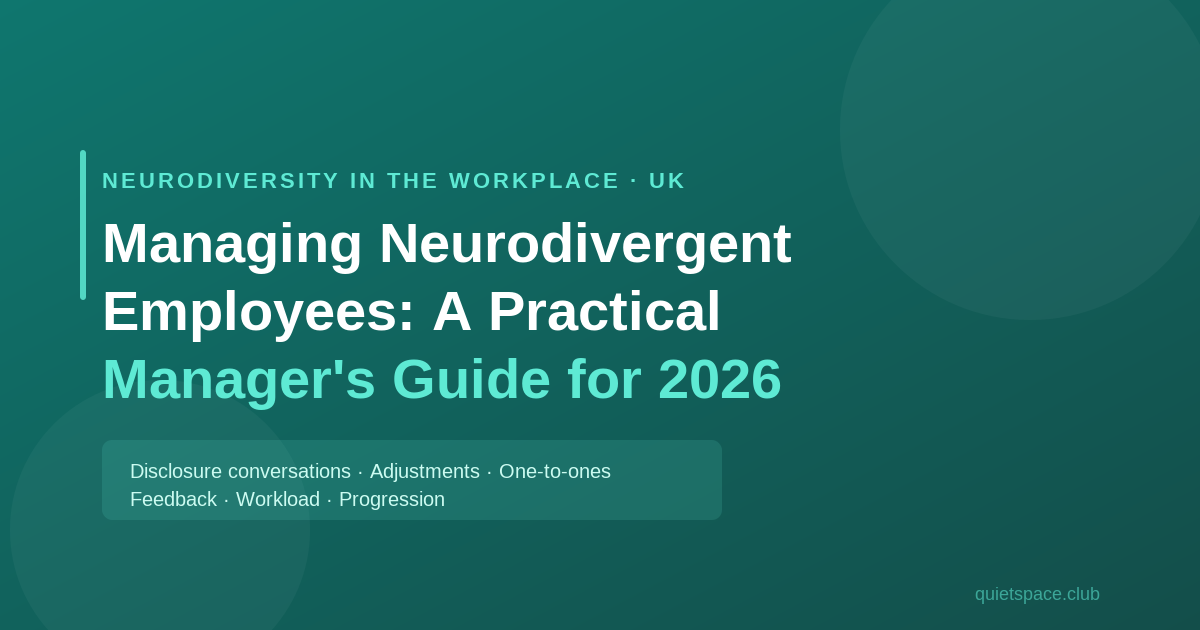
Line managers are where neuroinclusion succeeds or quietly fails. Policies do not implement themselves: almost every workplace adjustment passes through one manager's inbox, and Acas/YouGov data from 2026 shows 35% of UK workers say their employer is ineffective at training managers on neurodiversity. Meanwhile 70% of neurodivergent employees fear that disclosing will damage their career, and 60% do not know who to ask about adjustments. If you manage people, the odds are that someone on your team is managing a condition you know nothing about, and has concluded that telling you is not worth the risk.
This guide is deliberately behavioural. It is not about diagnosis — you are not required to understand ADHD or autism clinically, and you should not attempt to assess anyone. It is about what you say, what you change, and what you do in the following 48 hours. For the wider organisational picture, see our guide to neurodiversity in the workplace and the employer implementation guide.
The disclosure conversation
When someone tells you they are neurodivergent, they have usually rehearsed it and are watching your first five seconds closely. The goal of that conversation is not to solve anything. It is to establish that disclosure was safe and that something will happen next.
- Thank them, and say plainly that it will not affect how their work is judged.
- Ask one question: "What would make the biggest difference to your working day?" Do not ask about diagnosis, medication or severity.
- Do not say "we all struggle with that" or "you don't seem autistic". Both land as dismissal, however they were meant.
- Agree what you will do and by when, before the meeting ends.
- Confirm in writing the same day, and ask who else they are happy to share it with. Never pass it on beyond that.
Pro Tip
Do not wait for disclosure to make changes. Sending agendas in advance, following verbal instructions with a short written summary, and protecting focus time cost nothing, help the whole team, and remove the need for anyone to disclose in order to get basic conditions.
The first 48 hours after a request
| Timeframe | What the manager does |
|---|---|
| Same day | Written acknowledgement confirming what was asked for |
| Within 48 hours | Approve anything within your own authority — headphones, seating change, schedule change, meeting format |
| Within 5 working days | Route anything larger to the named adjustments owner, with a date and a copy to the employee |
| Within 20 working days | Implemented, or declined in writing with reasons and an alternative offered |
| At 6 weeks | Check whether the adjustment is actually working, and adjust it |
The most common failure is not refusal — it is the informal yes that never gets implemented. The employee reads that as a no, stops asking, and starts looking. Nearly one in four neurodivergent UK employees say they are planning to leave, and replacing them costs six to nine months of salary.
Day-to-day management practices that work
| Situation | What tends to fail | What works instead |
|---|---|---|
| Assigning work | Verbal briefing in a corridor, priorities implied | One written task list, explicitly ranked, one owner per task |
| One-to-ones | Open-ended "how are things?" | Fixed agenda sent in advance, same slot each week |
| Feedback | Sandwiched hints and social cues | Specific, behavioural, direct, in writing after the conversation |
| Meetings | Ad-hoc invites, no agenda, camera-on expectation | Agenda 24 hours ahead, camera optional, notes and actions circulated |
| Deadlines | Single distant deadline | Milestones and a check-in halfway, without micromanaging the method |
| Interruptions | Tapping someone on the shoulder mid-task | Asynchronous messages plus agreed protected focus blocks |
The part of the job most managers ignore: the room
Noise, lighting and unpredictability are the barriers neurodivergent employees name first, and return-to-office mandates have pushed them back up the list. You may not control the building, but you usually control seating, meeting rooms, hybrid patterns and whether focus time is respected. Move someone away from the walkway and the overhead fluorescent, book a quiet room for deep work, and let start times flex around rush hour.
Where your office genuinely cannot support focused work, assessed external space is a legitimate adjustment. NeuroIndex scores real UK workspaces on noise, lighting and sensory load — you can search assessed spaces and see how the scoring works.
The legal basics you personally need to know
- Under the Equality Act 2010, the duty to make reasonable adjustments is triggered by knowledge you have or reasonably ought to have — a formal diagnosis is not required.
- Most claims are for discrimination arising from disability: penalising lateness, communication style or absence that stems from the condition.
- Cost is rarely a valid reason to decline: most adjustments cost under £100, and Access to Work can fund more.
- Always give reasons in writing when declining, and offer an alternative. Neurodiversity-related tribunal claims have risen 164% in four years, and undocumented informal refusals are the pattern that appears in them.
Do not stall their career
Neurodivergent employees are markedly under-represented in UK management. It is rarely a single decision — it accumulates through vague promotion criteria such as "presence" or "cultural fit", stretch work handed to whoever is loudest in the meeting, and managers quietly deciding someone would not cope with leadership. Score promotions against explicit, observable criteria, offer development opportunities in writing rather than in the corridor, and check your own team's progression data.
Frequently asked questions
How should a manager respond when an employee discloses they are neurodivergent?
Thank them, confirm it will not affect how their work is judged, and ask what would make the biggest difference to their working day. Do not ask about diagnosis or severity. Agree a specific next step before the conversation ends, confirm it in writing the same day, and keep the disclosure confidential unless they agree otherwise.
What adjustments can a line manager approve without HR?
In most organisations a manager can approve low-cost, low-friction changes immediately: noise-cancelling headphones, a seating move, adjustable task lighting, flexible start times, written follow-ups to verbal instructions, agendas in advance and protected focus blocks. Anything requiring budget or assistive technology should be routed to the named adjustments owner within five working days.
Do I need a diagnosis before making adjustments?
No. The Equality Act duty is triggered by knowledge the employer has or reasonably ought to have, and waiting for a diagnosis in a system with long waiting lists is both bad practice and legally risky. Respond to the barrier the employee describes rather than to a document.
How do I manage performance concerns with a neurodivergent employee?
Separate the outcome from the method. Be specific and direct about the outcome required, put it in writing, and ask what is getting in the way before assuming a capability problem. Check whether agreed adjustments were actually implemented — an unimplemented adjustment is a common root cause of apparent underperformance and a weak position in any subsequent dispute.
What if the whole team wants the same flexibility?
Usually a good sign. Most neuro-inclusive practices — written communication, agendas in advance, quiet space, protected focus time — improve conditions for everyone, so extend them as team defaults and keep the individual adjustments that are genuinely specific.